What Would Raising Social Security’s Retirement Age Mean For Retirees?

You might have read that Social Security might raise its retirement age as a means to help fix the program’s financial challenges. If this happens, how could it affect you?


Lawmakers are considering raising the retirement age to shore up Social Security’s finances. Getty

The answer is…we don’t know for sure, and it will most likely depend on your age. However, we can gain insights by looking at how lawmakers implemented prior changes to Social Security benefits and by learning about potential changes that policy analysts have been examining.

We’ll also discuss other impacts on your retirement planning should lawmakers decide to increase the retirement ages for Social Security and Medicare.

What’s The Current Social Security Retirement Age?

Understanding Social Security’s retirement age isn’t straightforward and requires some explanation. Social Security uses two different terms to describe the same age: “normal retirement age” (NRA) and “full retirement age” (FRA). Both refer to the age at which you could start your Social Security retirement income and it wouldn’t be reduced should you choose to take “early retirement” or increased if you choose to delay your retirement.

It’s also the age at which Social Security’s benefit formula calculates something called your “primary insurance amount” (PIA), which forms the basis of the Social Security benefits you’ll receive.

For decades leading up to 1983, Social Security’s NRA was 65. However, the Social Security Amendment of 1983 introduced gradual increases to the NRA for people born in 1943 and after. The NRA was increased to age 66 for people born between 1943 and 1954, then it continued to increase gradually until it reached age 67 for people born in 1960 and after.

Social Security’s Retirement Age Terms Are Misleading

By the way, the “full retirement age” isn’t the age at which you could start your retirement income and receive the highest benefits you could possibly receive. To do that, you’d need to delay starting your benefits until age 70 to receive the full, delayed retirement credits that maximize your benefits.

And there’s nothing normal about the “normal retirement age.” According to one report , only about one-fourth of new retirees started benefits at that age in 2022; about half started their benefits at an earlier age.

When Was The Last Time The Retirement Age Was Changed?

The last major overhaul to Social Security occurred in 1983, when the normal retirement age was gradually raised from age 65 (for people born in 1942 or earlier) to age 67 (for people born in 1960 or later). This increase in retirement age was part of an overall package that improved Social Security’s finances by decreasing the value of benefits while also increasing the FICA taxes collected from workers.

It’s instructive to know that the changes to the retirement age applied to people who were age 40 or younger when the changes were adopted; those age 41 and older kept the normal retirement age of age 65. Our lawmakers at the time didn’t want to disrupt retirement plans for older workers.

What Could The Retirement Age Be Raised To?

Once again, Social Security is faced with long-term funding challenges, and there have been several proposals floated to reduce their long-term deficit. Predictably, Republican lawmakers generally prefer to reduce the deficit through benefit cuts, which would include raising the retirement age. For example, one Republican proposal would raise the normal retirement age (NRA) to age 70. This proposal would reduce the value of benefits of affected retirees by about 20%, according to one analysis. Democrat lawmakers, on the other hand, generally prefer to reduce the deficit primarily through increasing FICA taxes, largely on more affluent tax payers.

Another key feature to any proposal would be the age of current workers that’s grandfathered into the current retirement age schedule. For example, a different Republican proposal would phase in an increase to the normal retirement age from age 67 to age 69 over an eight-year period beginning in 2026. People who reach age 62 in 2033 or later would receive the full increase to age 69. The proposal would grandfather in people who’ve attained age 62 by 2025.

What Are The Pros And Cons For Raising The Retirement Age?

The primary reason to raise Social Security’s normal retirement age is to reduce the long-term deficit. A key rationale used by lawmakers who want to increase the retirement age is that Americans are living longer than previous generations of retirees. Unfortunately, however, recent gains in longevity have only benefited about half of the workforce, mostly leaving out lower-income workers and workers of color.

And that’s the key disadvantage of raising the retirement age: Future retirees who rely on Social Security the most would be the very people who would be disadvantaged the most by raising the retirement age.

More Details On Changing The Retirement Age

Raising Social Security’s NRA would have another detrimental impact on retirement planning—that’s the age when Social Security no longer applies the earnings test , which imposes a penalty for working at the same time as collecting benefits. Once you attain the NRA, there’s no longer a penalty for working while receiving benefits. Raising the NRA would make it more difficult for lower-income workers to supplement their Social Security benefits with earnings from working.

It’s also important to note that it’s highly unlikely that people who are currently receiving Social Security retirement benefit or workers within a few years of retirement would be impacted by any increases to the retirement age.

Finally, all the proposals discussed so far only apply to Social Security retirement income benefits. The age for eligibility for Medicare is currently age 65 and is another important retirement milestone. Republicans have been considering raising that age to 67 to help shore up Medicare’s finances.

How Would Raising The Retirement Age Affect Retirement Planning?

Any increases to Social Security’s or Medicare’s retirement age will make retirement more difficult for lower-income workers and retirees and for workers with physically demanding jobs. On the other hand, some workers may be able to push back their retirement date, particularly more affluent, white-collar workers who are able to or want to continue working into their late 60s or even to age 70.

It’s election season, and you’ll want to learn about the positions of the politicians you might vote for. So far, many politicians have been hesitant to propose positions that may be unpopular with voters. However, once we’re past the November elections, elected lawmakers may be more bold and propose changes to Social Security and Medicare. You’ll want to keep abreast of any proposals to increase retirement ages and learn how they might apply to you.


7 Threats To Your Financial Freedom In Retirement

Many factors determine how happy and fulfilling your retirement will be. Smart financial planning can increase your chances of maintaining financial freedom for as long as you live. Here are some of the biggest risks to having a secure and happy retirement I’ve seen over the past 20-plus years of helping people plan their retirement and achieve financial freedom.


7 threats to your financial freedom in retirement do not include drowning./Getty Images


Risk Of An Unhealthy Retirement

The more aches and pains you suffer, your retirement will likely be less satisfying. Knee pain might not kill you, but it could limit the activities you find enjoyable in retirement. I am writing this as a healthy financial planner, not a health expert. All of us have room to improve how we eat. We can also take steps today to increase our health span in retirement (increasing our healthy years as we age).

Being healthier will afford you more opportunities for a happy and fulfilling retirement . However, being unhealthy could place limitations on you and be quite expensive. According to the Fidelity Retiree Health Care Cost Estimate, the average couple retiring at age 65 in 2022 may need approximately $315,000 saved (after tax) to cover healthcare expenses in retirement. This staggering number is your out-of-pocket cost taking into account insurance. While reducing the number of preventable, chronic illnesses you may need to treat won’t eliminate your medical expenses, it will likely reduce them.

Longevity Risk In Retirement

Many of the signs of aging won’t kill us anytime soon. I don’t recall anyone dying from an overabundance of fine lines and wrinkles. One of the biggest risks to your financial freedom in retirement is living longer than expected or outliving your savings and investments. Fewer retirees have pensions or guaranteed lifetime income (beyond Social Security ).

Retirees should be aware that their retirement savings may need to last longer than expected.

The Risk Of Not Saving Enough For Retirement

Ideally, by the time you retire, you should have saved nine to 10 times your annual salary. These numbers may vary depending on your lifestyle expenses, health, and other factors, such as having paid or nearly paid off your home mortgage .

If you are still working, take the time to develop a financial roadmap to increase your savings and get on track for financial freedom in retirement.

Retirement Risk Of Spending Too Much

There are some costs you have limited control over after you have retired. These include things like rent, medical care, and just just plain inflation eroding the purchasing power of your retirement income. For the average retiree who did not save enough for retirement, living off the income provided by your retirement assets and Social Security will not be possible. That is not to say you can’t minimize spending in certain areas to reduce the risk of running out of money.

While you don’t control tax rates, tax planning can help you keep more of your retirement income.

Inflation Risk To Retirement Security

Even the best-laid retirement plans are affected by inflation. Until recently, we had been in a low-inflation environment. Even then, retirees would see their purchasing power cut in half over a 30-year retirement. As inflation rates increase, the drop in purchasing power is reduced at an even faster pace. For example, with 8% annual inflation, your purchase power will be cut in half in just nine years.

Lack Of Stock Market Risk

While you can’t control inflation, you can plan for it. Putting all your money into a fixed annuity, bank account, or CD with guaranteed returns may be tempting, but those options likely won’t keep you ahead of inflation. The younger and/or healthier you are, the more your investment portfolio should be invested in stocks (or stock-based ETFs or Mutual Funds).

Stock Market Risk

It seems many retirees view the stock market as the biggest risk to their retirement income. To be fair, if the stock market never went down and returned 30% or more each year, many people would still only see their financial issues reduced, but not always eliminated during retirement.

As we saw in 2022, the stock market does, in fact, go down, and the drops can be quite painful. However, if you zoom out and look at how much money the stock market has made over time (including every down day), the stock market outpaces bonds, bank accounts, and even real estate.

Unfortunately, annual studies by DALBAR — a leading financial services marketing firm — have shown that the average investor greatly underperforms the stock market and, in many cases, even underperforms their own in investments. People often buy or sell investments at the absolute worst time.

You may be at a bigger risk from some of these seven financial freedom destroyers depending on your circumstances.

Reaching Retirement: Now What?

You’ve worked hard your whole life anticipating the day you could finally retire. Congratulations — that day has arrived! But with it comes the realization that you’ll need to carefully manage your assets to give them lasting potential.

Review your portfolio regularly

Traditional wisdom holds that retirees should value the safety of their principal above all else. For this reason, you may assume your investment portfolio should be shifted to all fixed-income investments, such as bonds and money market accounts. The problem with this approach is that you’ll effectively lose purchasing power if the return on your investments doesn’t keep up with inflation.

While generally it makes sense for your portfolio to become progressively more conservative as you grow older, it may be wise to consider maintaining at least a portion of your portfolio in growth investments.

Spend wisely

Don’t assume that you’ll be able to live on the earnings generated by your investment portfolio and retirement accounts for the rest of your life. At some point, you’ll probably have to start drawing on the principal. But you’ll want to be careful not to spend too much too soon. This can be a great temptation, particularly early in retirement.

A good guideline is to make sure your annual withdrawal rate isn’t greater than 4% to 6% of your portfolio. (The appropriate percentage for you will depend on a number of factors, including the length of your payout period and your portfolio’s asset allocation.) Remember that if you whittle away your principal too quickly, you may not be able to earn enough on the remaining principal to carry you through the later years.

Understand your retirement plan distribution options

Most traditional pension plans pay benefits in the form of an annuity. If you’re married, you generally must choose between a higher retirement benefit paid over your lifetime, or a smaller benefit that continues to your spouse after your death. A financial professional can help you with this difficult, but important, decision.

Historically, other employer retirement plans, such as 401(k)s, typically haven’t offered annuities; however, this is changing as a result of legislation passed in 2019 that makes it easier for employers to offer such products. If your plan offers an annuity as a distribution option, you may want to consider how it might fit in your long-term plan.

You might also consider whether it makes sense to roll your employer retirement account into a traditional IRA, which typically has flexible withdrawal options. If you decide to work for another employer, you might also be able to transfer assets you’ve accumulated to your new employer’s plan, if allowed.1

Finally, you may also choose to take a lump-sum distribution from your work-based retirement plan; however, this could incur a substantial tax obligation and a possible 10% penalty on the tax-deferred portion of the amount if you are under age 59½, unless an exception applies.

Plan for required distributions

Keep in mind that you must generally begin taking required minimum distributions (RMDs) from employer retirement plans and traditional IRAs after you reach age 73 (75 for those who reach age 73 after December 31, 2032), whether you need them or not.2

If you own a Roth IRA, you aren’t required to take any distributions during your lifetime. Your funds can continue to grow tax deferred, and qualified distributions will be tax free.3 Because of these unique tax benefits, it may make sense to withdraw funds from a Roth IRA last.

Know your Social Security options

You’ll need to decide when to start receiving your Social Security retirement benefits. At normal retirement age (which varies from 66 to 67, depending on the year you were born), you can receive your full Social Security retirement benefit. You can elect to receive your Social Security retirement benefit as early as age 62, but if you begin receiving your benefit before your normal retirement age, your benefit will be reduced. Conversely, if you delay retirement, you can increase your Social Security retirement benefit.

Consider phasing

For many workers, the sudden change from employee to retiree can be a difficult one. Some employers, especially those in the public sector, have begun offering “phased retirement” plans to address this problem. Phased retirement generally allows you to continue working on a part-time basis — you benefit by having a smoother transition from full-time employment to retirement, and your employer benefits by retaining the services of a talented employee. Some phased retirement plans even allow you to access all or part of your pension benefit while you work part time.

Of course, to the extent you are able to support yourself with a salary, the less you’ll need to dip into your retirement savings. Another advantage of delaying full retirement is that you can continue to build tax-deferred funds in your IRA or employer-sponsored retirement plan. As mentioned earlier, however, you generally will be required to start taking RMDs from most employer-sponsored plans and traditional IRAs once you reach age 73, if you want to avoid substantial penalties.2

If you do continue to work, make sure you understand the consequences. Some pension plans base your retirement benefit on your final average pay. If you work part time, your pension benefit may be reduced because your pay has gone down. Remember, too, that income from a job may affect the amount of Social Security retirement benefit you receive if you are under normal retirement age. But once you reach normal retirement age, you can earn as much as you want without affecting your Social Security retirement benefit.

Facing a shortfall

What if you’re nearing retirement and you determine that your retirement income may not be adequate to meet your retirement expenses? If retirement is just around the corner, you may need to drastically change your spending and saving habits. Saving even a little money can really add up if you do it consistently and earn a reasonable rate of return. And by making permanent changes to your spending habits, your savings could last even longer. Start by preparing a budget to see where your money is going. Here are some suggested ways to stretch your retirement dollars:

  • Refinance your home mortgage if interest rates have dropped since you obtained your loan, or reduce your housing expenses by moving to a less expensive home or apartment.
  • Access the equity in your home. Use the proceeds from a second mortgage or home equity line of credit to pay off higher-interest-rate debts, or consider a reverse mortgage. (Consider these strategies very carefully before making any final decisions.)
  • Sell one of your cars if you have two. When your remaining car needs to be replaced, consider buying a used one.
  • Transfer credit card balances from higher-interest cards to a low- or no-interest card, and then cancel the old accounts.
  • Ask about insurance discounts and review your insurance needs (e.g., your need for life insurance may have lessened).
  • Reduce discretionary expenses such as lunches and dinners out.

By planning carefully, investing wisely, and spending thoughtfully, you can increase the likelihood that your retirement will be a financially comfortable one.

When considering a rollover, to either an IRA or to another employer’s retirement plan, you should consider carefully the investment options, fees and expenses, services, ability to make penalty-free withdrawals, degree of creditor protection, and distribution requirements associated with each option.

If you are still employed and own no more than 5% of your company, you may be able to delay RMDs from your current employer’s plan until after you actually retire. You will have to take RMDs from IRAs and plans from former employers.

To qualify for tax-free and penalty-free withdrawal of earnings, a Roth IRA must meet a five-year holding requirement and the distribution must take place after age 59½, with certain exceptions.

Asset allocation and diversification are methods used to help manage investment risk; they do not guarantee a profit or protect against investment loss.

The decision of when and how to tap your Social Security benefits can be complicated. You might want to review your options long before your planned retirement date to be sure you fully understand the pros and cons of each.

This content has been reviewed by FINRA.

Taking Advantage of Employer-Sponsored Retirement Plans

Employer-sponsored qualified retirement plans such as 401(k)s are some of the most powerful retirement savings tools available. If your employer offers such a plan and you’re not participating in it, you should be. Once you’re participating in a plan, try to take full advantage of it.

Understand your employer-sponsored plan

Before you can take advantage of your employer’s plan, you need to understand how these plans work. Read everything you can about the plan and talk to your employer’s benefits officer. You can also talk to a financial planner, a tax advisor, and other professionals. Recognize the key features that many employer-sponsored plans share:

  • Your employer automatically deducts your contributions from your paycheck. You may never even miss the money — out of sight, out of mind.
  • You decide what portion of your salary to contribute, up to the legal limit. And you can usually change your contribution amount on certain dates during the year or as needed.
  • With 401(k), 403(b), 457(b), SEP IRAs, and SIMPLE plans, you contribute to the plan on a pre-tax basis. Your contributions come off the top of your salary before your employer withholds income taxes.
  • Your retirement plan may let you make after-tax Roth contributions — there’s no up-front tax benefit but qualified distributions are entirely tax free.
  • Your employer may match all or part of your contribution up to a certain level. You typically become vested in these employer dollars through years of service with the company.
  • Your funds grow tax deferred in the plan. You don’t pay taxes on investment earnings until you withdraw your money from the plan.
  • You’ll pay income taxes (and possibly an early withdrawal penalty) if you withdraw your money from the plan.
  • If your plan allows loans, you may be able to borrow a portion of your vested balance, up to specified limits.
  • Your creditors cannot reach your plan funds to satisfy your debts.

Contribute as much as possible

The more you can save for retirement, the better your chances of retiring comfortably. If you can, max out your contribution up to the legal limit (or plan limits, if lower). If you need to free up money to do that, try to cut certain expenses.

Why put your retirement dollars in your employer’s plan instead of somewhere else? One reason is that your pre-tax contributions to your employer’s plan lower your taxable income for the year. This means you save money in taxes when you contribute to the plan — a big advantage if you’re in a high tax bracket. For example, if you earn $100,000 a year and contribute $10,000 to a 401(k) plan, you’ll pay income taxes on $90,000 instead of $100,000. Keep in mind that distributions will be subject to income tax.

Another reason is the power of tax-deferred growth. Your investment earnings compound year after year and aren’t taxable as long as they remain in the plan. Over the long term, this gives you the opportunity to build an impressive sum in your employer’s plan. You should end u½p with a much larger balance than somebody who invests the same amount in taxable investments at the same rate of return.

For example, say you participate in your employer’s tax-deferred plan (Account A). You also have a taxable investment account (Account B). Each account earns 6% per year. You’re in the 24% tax bracket and contribute $5,000 to each account at the end of every year. After 40 years, the money placed in a taxable account would be worth $567,680. During the same period, the tax-deferred account would grow to $820,238. Even after taxes have been deducted from the tax-deferred account, the investor would still receive $623,381. (Note: This example is for illustrative purposes only and does not represent a specific investment.)

Roth contributions are after-tax contributions, and therefore do not offer the up-front pre-tax benefit. However, Roth earnings grow tax-deferred and qualified distributions from Roth accounts are tax free. A qualified distribution is one made after five years and the account owner reaches age 59½, becomes disabled, or dies.

Capture the full employer match

If you can’t max out your 401(k) or other plan, you should at least try to contribute up to the limit your employer will match. Employer contributions are basically free money once you’re vested in them (check with your employer to find out when vesting happens). By capturing the full benefit of your employer’s match, you’ll be surprised how much faster your balance grows. If you don’t take advantage of your employer’s generosity, you could be passing up a significant return on your money.

For example, you earn $30,000 a year and work for an employer that has a matching 401(k) plan. The match is 50 cents on the dollar up to 6% of your salary. Each year, you contribute 6% of your salary ($1,800) to the plan and receive a matching contribution of $900 from your employer.

Evaluate your investment choices carefully

Most employer-sponsored plans give you a selection of mutual funds or other investments to choose from. Make your choices carefully. The right investment mix for your employer’s plan could be one of your keys to a comfortable retirement. That’s because over the long term, varying rates of return can make a big difference in the size of your balance.

Note: Before investing in a mutual fund, carefully consider the investment objectives, risks, charges, and expenses of the fund. This information can be found in the prospectus, which can be obtained from the fund. Read it carefully before investing.

Research the investments available to you. How have they performed over the long term? How much risk will they expose you to? Which ones are best suited for long-term goals like retirement? You may also want to get advice from a financial professional (either your own or one provided through your plan), who can help you pick the right investments based on your personal goals, your attitude toward risk, how long you have until retirement, and other factors. Your financial professional can also help you coordinate your plan investments with your overall investment portfolio.

Know your options when you leave your employer

When you leave your job, your vested balance in your former employer’s retirement plan is yours to keep. You have several options at that point, including:

  • Taking a lump-sum distribution. Before choosing this option, consider that you’ll pay income taxes and possibly a penalty on the amount you withdraw. Plus, you’re giving up the continued potential of tax-deferred growth.
  • Leaving your funds in the old plan, growing tax deferred. (Your old plan may not permit this if your balance is less than $5,000 ($7,000 in 2024), or if you’ve reached the plan’s normal retirement age — typically age 65.) This may be a good idea if you’re happy with the plan’s investments or you need time to decide what to do with your money.
  • Rolling your funds over to an IRA or a new employer’s plan (if the plan accepts rollovers). This may also be an appropriate move because there will be no income taxes or penalties if you do the rollover properly (your old plan will withhold 20% for income taxes if you receive the funds before rolling them over, and you’ll need to make up this amount out of pocket when investing in the new plan or IRA). Plus, your funds continue to potentially benefit from tax-deferred growth .

Distributions from traditional retirement savings accounts and non-qualified distributions from Roth accounts will be subject to income tax. In addition, distributions prior to age 59½ will be subject to a 10% penalty, unless an exception applies.

This content has been reviewed by FINRA.

Closing a Retirement Income Gap

When you determine how much income you’ll need in retirement, you may base your projection on the type of lifestyle you plan to have and when you want to retire. However, as you grow closer to retirement, you may discover that your income won’t be enough to meet your needs. If you find yourself in this situation, you’ll need to adopt a plan to bridge this projected income gap.

Delay retirement: 65 is just a number

One way of dealing with a projected income shortfall is to stay in the workforce longer than you had planned. This will allow you to continue supporting yourself with a salary rather than dipping into your retirement savings. Depending on your income, this could also increase your Social Security retirement benefit. You’ll also be able to delay taking your Social Security benefit or distributions from retirement accounts.

At full retirement age (which varies, depending on the year you were born), you will receive your full Social Security retirement benefit. You can elect to receive your Social Security retirement benefit as early as age 62, but if you begin receiving your benefit before your full retirement age, your benefit will be reduced. Conversely, if you delay retirement, you can increase your Social Security benefit.

Remember, too, that income from a job may affect the amount of Social Security retirement benefit you receive if you are under full retirement age — $1 in benefits will be withheld for every $2 you earn over a certain earnings limit ($22.320 in 2024). In the year you reach full retirement age, different rules apply; $1 in benefits will be withheld for every $3 you earn over the annual earnings limit ($59,520 in 2024). Once you reach your full retirement age, you can earn as much as you want without affecting your Social Security retirement benefit.

Another advantage of delaying retirement is that you can continue to build tax-deferred (or in the case of Roth accounts, tax-free) funds in your IRA or employer-sponsored retirement plan. Keep in mind, though, that you may be required to start taking minimum distributions from your qualified retirement plan or traditional IRA once you reach age 73 (75 for those who reach age 73 after December 31, 2032), if you want to avoid harsh penalties.

And if you’re covered by a pension plan at work, you could also consider retiring and then seeking employment elsewhere. This way you can receive a salary and your pension benefit at the same time. Some employers, to avoid losing talented employees this way, offer “phased retirement” programs that allow you to receive all or part of your pension benefit while you’re still working. Make sure you understand your pension plan options.

Spend less, save more

You may be able to deal with an income shortfall by adjusting your spending habits. If you’re still years away from retirement, you may be able to get by with a few minor changes. However, if retirement is just around the corner, you may need to drastically change your spending and saving habits. Saving even a little money can really add up if you do it consistently and earn a reasonable rate of return. Make permanent changes to your spending habits and you’ll find that your savings will last even longer. Start by preparing a budget to see where your money is going. Here are some suggested ways to stretch your retirement dollars:

  • Refinance your home mortgage if interest rates have dropped since you took the loan.
  • Reduce your housing expenses by moving to a less expensive home or apartment.
  • Sell one of your cars if you have two. When your remaining car needs to be replaced, consider buying a used one.
  • Access the equity in your home. Use the proceeds from a second mortgage or home equity line of credit to pay off higher-interest-rate debts.
  • Transfer credit card balances from higher-interest cards to a low- or no-interest card, and then cancel the old accounts.
  • Ask about insurance discounts and review your insurance needs (e.g., your need for life insurance may have lessened).
  • Reduce discretionary expenses such as lunches and dinners out.

Earmark the money you save for retirement and invest it immediately. If you can take advantage of an IRA, 401(k), or other tax-deferred retirement plan, you should do so. Funds invested in a tax-deferred account may grow more rapidly than funds invested in a non-tax-deferred account.

Reallocate your assets: consider investing more aggressively

Some people make the mistake of investing too conservatively to achieve their retirement goals. That’s not surprising, because as you take on more risk, your potential for loss grows as well. But greater risk also generally entails potentially greater reward. And with life expectancies rising and people retiring earlier, retirement funds need to last a long time.

That’s why if you are facing a projected income shortfall, you may want to consider shifting some of your assets to investments that have the potential to substantially outpace inflation. The amount of investment dollars you might consider keeping in growth-oriented investments depends on your time horizon (how long you have to save) and your tolerance for risk. In general, the longer you have until retirement, the more aggressive you can typically afford to be. Still, if you are at or near retirement, you may want to keep some of your funds in growth-oriented investments, even if you decide to keep the bulk of your funds in more conservative, fixed-income investments. Get advice from a financial professional if you need help deciding how your assets should be allocated.

And remember, no matter how you decide to allocate your money, rebalance your portfolio periodically. Your needs will change over time, and so should your investment strategy. Note: Rebalancing may carry tax consequences. Asset allocation and diversification cannot guarantee a profit or insure against a loss. There is no guarantee that any investment strategy will be successful; all investing involves risk, including the possible loss of principal.

Accept reality: lower your standard of living

If your projected income shortfall is severe enough or if you’re already close to retirement, you may realize that no matter what measures you take, you will not be able to afford the retirement lifestyle you’ve dreamed of. In other words, you will have to lower your expectations and accept a lower standard of living.

Fortunately, this may be easier to do than when you were younger. Although some expenses, like health care, generally increase in retirement, other expenses, like housing costs and automobile expenses, tend to decrease. And it’s likely that your days of paying college bills and growing-family expenses are over.

Once you are within a few years of retirement, you can prepare a realistic budget that will help you manage your money in retirement. Think long term: Retirees frequently get into budget trouble in the early years of retirement, when they are adjusting to their new lifestyles. Remember that when you are retired, every day is Saturday, so it’s easy to start overspending.

How To Prevent A Retirement Bummer

Many workers approaching retirement today haven’t saved enough for the retirement of their dreams. But that doesn’t need to be a bummer: You can take charge of the rest of your life by informing yourself and taking appropriate action steps.

Let’s start by looking at the average benefits today’s pre-retirees might expect.

Most Pre-Retirees Will Fall Short Of Common Retirement Income Goals

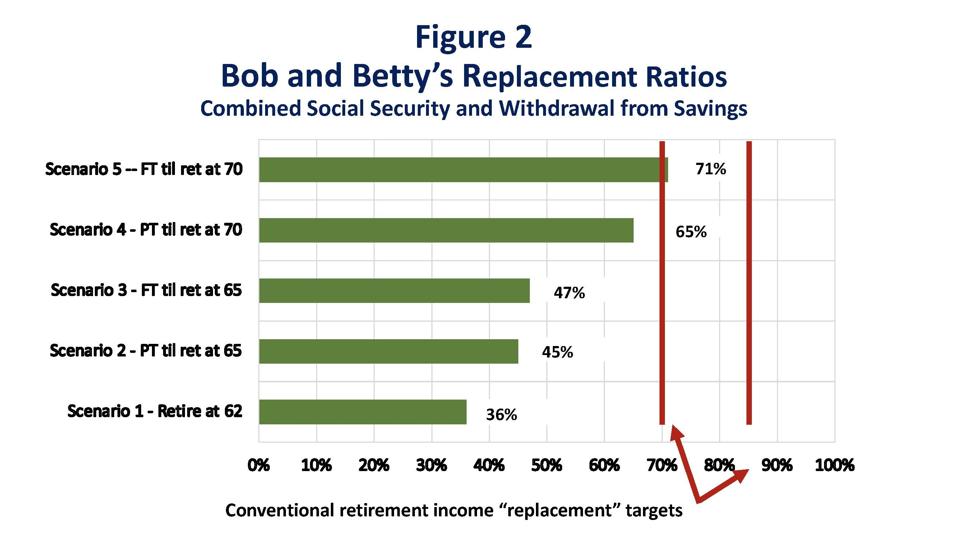
Retirement planners commonly recommend that to be comfortable in retirement, you need a total retirement income that replaces 70% to 85% of your gross pre-retirement pay before taxes. These goals are designed to approximately replace all the after-tax, spendable income you enjoyed while you were working. Unfortunately, most retirees will fall short of these goals.

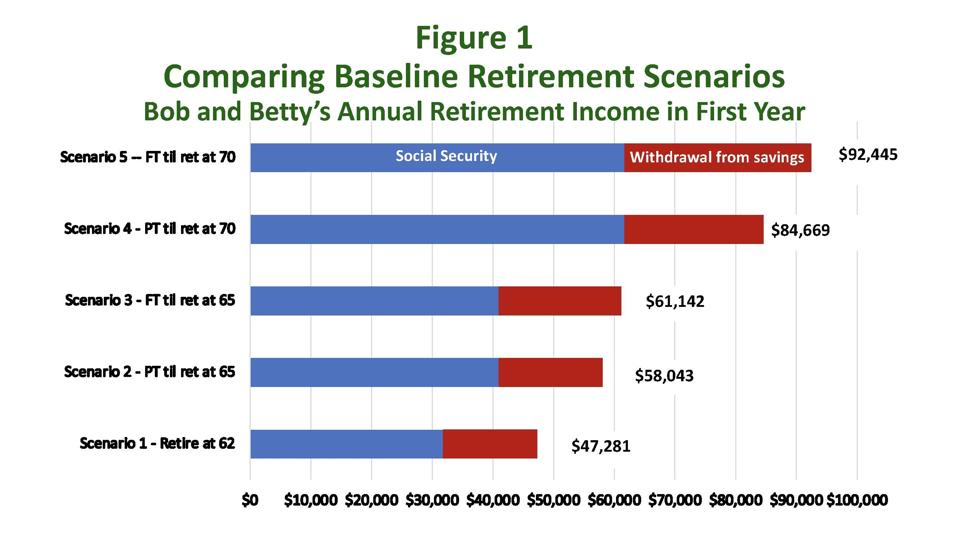
Here’s an example that illustrates the shortfall from this goal that today’s pre-retirees might expect. Let’s look at a hypothetical married couple, Bob and Betty. They’re both age 60, work full time, and can be considered representative of today’s pre-retirees. They’re considering at which age they can afford to retire—62, 65, or 70—so they’re estimating their total retirement income at those ages.

Bob and Betty are examining five possible scenarios:

  • Scenario 1: Both work until age 62, then they retire full time by starting their Social Security benefits and starting regular withdrawals from their retirement savings.
  • Scenario 2: Both work part time from ages 60 to 65, then they both retire full time.
  • Scenario 3: Both work full time from ages 60 to 65, then they both retire full time.
  • Scenario 4: Both work part time from ages 60 to 70, then they both retire full time.
  • Scenario 5: Both work full time from ages 60 to 70, then they both retire full time.

Figure 1 shows estimates of their retirement income under each scenario, combining Social Security income with regular, systematic withdrawals from their retirement savings.

Source: Steve Vernon

Figure 1 shows that their retirement income increases significantly if they delay their retirement, almost doubling between retiring at age 62 and retiring at age 70. It also illustrates the potential for working part time for a while; there isn’t a big difference in the estimated retirement incomes between part-time and full-time work in scenarios 2 and 3 and scenarios 4 and 5.

Figure 2 below shows Bob and Betty’s total estimated retirement income as a percentage of their pre-retirement pay (their “replacement ratio”), combining Social Security with their regular withdrawals from savings.

Source: Steve Vernon

Figure 2 shows that Bob and Betty don’t approach the common replacement goal amounts unless they wait to retire until age 70.

Bob and Betty’s example displays the basic retirement reality facing today’s pre-retirees: They’ll either need to work longer than they’d hoped, reduce their spending in retirement, or some combination. Most of today’s pre-retirees will face the same situation, even though their circumstances might be different from Bob and Betty.

By the way, if you’re interested, I’ve summarized the assumptions made for Bob and Betty’s example at the end of this post.

Action Steps To Prevent Your Retirement Bummer

Of course, your situation will be different from Bob and Betty’s. As a result, the first step is to learn about your own retirement situation:

  • Estimate your Social Security benefits using one of the calculators on the Social Security website .
  • Take inventory of your living expenses and how they might change in retirement.
  • Add up your retirement savings from all your IRAs, 401k accounts, investment accounts, etc.

Then you’ll be ready to consider these action steps:

  • Learn how you can increase your Social Security benefits.
  • Learn about the various methods you can use to generate regular retirement paychecks from your retirement savings. You might use different methods from the withdrawal strategy that Bob and Betty planned to use; these different methods might produce higher retirement income.
  • Investigate ways to work longer and still give yourself time to enjoy life.
  • Explore ways to reduce your spending in retirement.

It will take some time and effort to carry out these action steps. If you don’t feel comfortable doing that on your own, you might need to work with a qualified retirement advisor who has your best interests at heart.

I’ve seen several older friends and relatives run low on money in their 80s, experiencing their own retirement bummer due to making uninformed decisions at the time they retired. To avoid their fate, it’s well worth the effort to plan ahead—your quality of life and financial security for 20 to 30 years is at stake.

Assumptions for the example

Here are my assumptions for Bob and Betty’s situation:

  • They each earn $65,000 per year, a little higher than the average wages covered by Social Security . As a result, their household income is $130,000 per year.
  • They’ve saved $500,000 for retirement, significantly higher than the median savings $204,000 for households aged 55 to 64 according to one report .
  • Neither have earned a traditional pension benefit.
  • The amounts shown in Figure 1 are expressed in today’s dollars and aren’t adjusted for inflation.
  • Their savings earn 3% per year, after inflation, until they retire.
  • When they work part time, they’ll no longer contribute to their retirement savings. When they work full time, they’ll contribute a total of 15% of their pay to retirement savings, which includes their employer’s match.
  • To calculate their annual withdrawal from savings, they use the methodology of the IRS required minimum distribution . This is a conservative withdrawal method that’s intended to produce retirement income for life, although there’s no guarantee that will happen.

Different methods and assumptions could produce different results, but often not significantly changing the overall conclusions.

Social Security Retirement Benefit Basics

Social Security benefits are a major source of retirement income for most people. Your Social Security retirement benefit is based on the number of years you’ve been working and the amount you’ve earned. When you begin taking Social Security benefits also greatly affects the size of your benefit.

How do you qualify for retirement benefits?

When you work and pay Social Security taxes (FICA on some pay stubs), you earn Social Security credits. You can earn up to 4 credits each year. You need at least 40 credits (10 years of work) to be eligible for retirement benefits.

How much will your retirement benefit be?

The Social Security Administration (SSA) calculates your primary insurance amount (PIA), upon which your retirement benefit will be based, using a formula that takes into account your 35 highest earnings years. At your full retirement age, you’ll be entitled to receive that amount. This is known as your full retirement benefit. Because your retirement benefit is based on your average earnings over your working career, if you have some years of no earnings or low earnings, your benefit amount may be lower than if you had worked steadily.

Your age at the time you start receiving benefits also affects your benefit amount. Although you can retire early at age 62, the longer you wait to begin receiving your benefit (up to age 70), the more you’ll receive each month.

You can estimate your retirement benefit under current law by using the benefit calculators available on the SSA’s website, ssa.gov. You can also sign up for a my Social Security account so that you can view your online Social Security Statement. Your statement contains a detailed record of your earnings, as well as estimates of retirement, survivor, and disability benefits. If you’re not registered for an online account and are not yet receiving benefits, you’ll receive a statement in the mail every year, starting at age 60.

Retiring at full retirement age

Your full retirement age depends on the year in which you were born. If you retire at full retirement age, you’ll receive an unreduced retirement benefit.

If you were born in:Your full retirement age is:
1943-195466
195566 and 2 months
195666 and 4 months
195766 and 6 months
195866 and 8 months
195966 and 10 months
1960 or later67

If you were born on January 1 of any year, refer to the previous year to determine your full retirement age.

Retiring early will reduce your benefit

You can begin receiving Social Security benefits before your full retirement age, as early as age 62. However, if you begin receiving benefits early, your Social Security benefit will be less than if you wait until your full retirement age to begin receiving benefits. Your retirement benefit will be reduced by 5/9ths of 1% for every month between your retirement date and your full retirement age, up to 36 months, then by 5/12ths of 1% thereafter. This reduction is permanent — you won’t be eligible for a benefit increase once you reach full retirement age. However, even though your monthly benefit will be less, you might receive the same or more total lifetime benefits as you would have had you waited until full retirement age to start collecting benefits. That’s because even though you’ll receive less per month, you might receive benefits over a longer period of time.

Delaying retirement will increase your benefit

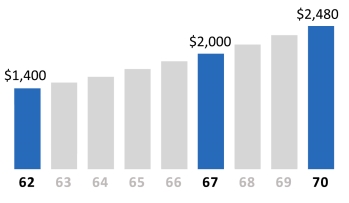
For each month that you delay receiving Social Security retirement benefits past your full retirement age, your benefit will permanently increase by a certain percentage, up to the maximum age of 70. For anyone born in 1943 or later, the monthly percentage is 2/3 of 1%, so the annual percentage is 8%. So, for example, if your full retirement age is 67 and you delay receiving benefits for 3 years, your benefit at age 70 will be 24% higher than at age 67.

Monthly benefit example

The following chart illustrates how much a monthly benefit of $2,000 taken at a full retirement age of 67 would be worth if taken earlier or later than full retirement age. For example, as this chart shows, this $2,000 benefit would be worth $1,400 if taken at age 62, and $2,480 if taken at age 70.

This hypothetical illustration is based on Social Security Administration rules. Actual results will vary.

Working may affect your retirement benefit

You can work and still receive Social Security retirement benefits, but the income that you earn before you reach full retirement age may temporarily affect your benefit. Here’s how:

  • If you’re under full retirement age for the entire year, $1 of your benefit will be withheld for every $2 you earn over the annual earnings limit ($22,320 in 2024)
  • A higher earnings limit applies in the year you reach full retirement age, and the calculation is different, too — $1 of your benefit will be withheld for every $3 you earn over $59,520 (in 2024)

Once you reach full retirement age, you can work and earn as much income as you want without reducing your Social Security retirement benefit. And keep in mind that if some of your benefits are withheld prior to your full retirement age, you’ll generally receive a higher monthly benefit at full retirement age, because after retirement age the SSA recalculates your benefit every year and gives you credit for those withheld earnings.

Retirement benefits for qualified family members

Even if your spouse has never worked outside your home or in a job covered by Social Security, he or she may be eligible for spousal benefits based on your Social Security earnings record. Other members of your family may also be eligible. Retirement benefits are generally paid to family members who relied on your income for financial support. If you’re receiving retirement benefits, the members of your family who may be eligible for family benefits include:

  • Your spouse age 62 or older, if married at least 1 year
  • Your former spouse age 62 or older, if you were married at least 10 years
  • Your spouse or former spouse at any age, if caring for your child who is under age 16 or disabled
  • Your children under age 18, if unmarried
  • Your children under age 19, if full-time students (through grade 12) or disabled
  • Your children older than 18, if severely disabled

Your eligible family members will receive a monthly benefit that is as much as 50% of your benefit. However, the amount that can be paid each month to a family is limited. The total benefit that your family can receive based on your earnings record is about 150% to 180% of your full retirement benefit amount. If the total family benefit exceeds this limit, each family member’s benefit will be reduced proportionately. Your benefit won’t be affected.

For more information on retirement benefits or the application process, contact the Social Security Administration at (800) 772-1213 or visit ssa.gov.

Signing up for Social Security

According to the Social Security Administration, you should apply for Social Security benefits approximately three months before your retirement date. To apply for Social Security benefits, you can fill out an application online or call or visit your local Social Security office. You can also call the SSA at (800) 772-1213 to discuss your options or to get more information about the application process.

This content has been reviewed by FINRA.

Saving for Retirement

Although most of us recognize the importance of sound retirement planning, few of us embrace the nitty-gritty work involved. With thousands of investment possibilities, complex rules governing retirement plans, and the unpredictable future of consumer prices, most people don’t even know where to begin. Here are some suggestions to help you get started.

Determine your retirement income needs

Depending on your desired retirement lifestyle, you may need anywhere from 60% to 100% of your current income to maintain your current standard of living. But this is only a general guideline. To determine your specific needs, you may want to estimate your annual retirement expenses.

Use your current expenses as a starting point, but note that your expenses may change dramatically by the time you retire. If you’re nearing retirement, the gap between your current expenses and your retirement expenses may be small. If retirement is many years away, the gap may be significant, and projecting your future expenses may be more difficult.

Remember to take inflation into account. The purchasing power of a dollar declines each year as prices rise. And keep in mind that your annual expenses may fluctuate throughout retirement. For instance, if you own a home and are paying a mortgage, your expenses will likely drop if the mortgage is paid off by the time you retire. Other expenses, such as health-related expenses, may increase in your later retirement years. A realistic estimate of your expenses will tell you about how much annual income you may need to live comfortably.

Calculate the gap

Once you have estimated your retirement income needs, take stock of your estimated future assets and income. These may come from Social Security, a retirement plan at work, a part-time job, and other sources. If estimates show that your future assets and income will fall short of what you may need, the rest will have to come from additional personal retirement savings.

Figure out how much you’ll need to save

By the time you retire, you’ll need a nest egg that will provide you with enough income to fill the gap left by your other income sources. But exactly how much is enough? The following questions may help you find the answer:

  • At what age do you plan to retire? The younger you retire, the longer your retirement will be, and the more money you’ll need to carry you through it.
  • What kind of lifestyle do you hope to maintain during your retirement years?
  • What is your life expectancy? The longer you live, the more years of retirement you’ll have to fund.
  • What rate of growth can you expect from your savings now and during retirement? Be conservative when projecting rates of return.
  • Do you expect to dip into your principal? If so, you may deplete your savings faster than if you just live off investment earnings. Build in a cushion to guard against these risks.

Build your retirement fund: Save, save, save

When you estimate roughly how much money you’ll need, your next goal is to save that amount. First, you’ll have to map out a savings plan that works for you. Assume a conservative rate of return (which will depend on your risk tolerance), and then determine approximately how much you’ll need to save every year between now and your retirement to pursue your goal.

The next step is to put your savings plan into action. It’s never too early to get started (ideally, begin saving in your 20s). To the extent possible, you may want to arrange to have certain amounts taken directly from your paycheck and automatically invested in accounts of your choice [e.g., 401(k) plans, payroll deduction savings]. This arrangement reduces the risk of impulsive or unwise spending that will threaten your savings plan. If possible, save more than you think you’ll need to provide a cushion.

Consider the various savings tools

Employer-sponsored retirement plans like 401(k)s and 403(b)s are powerful savings tools. Your contributions come out of your salary as pre-tax contributions (reducing your current taxable income) and any investment earnings grow tax deferred until withdrawn. Some 401(k), 403(b), and 457(b) plans also allow employees to make after-tax “Roth” contributions. There’s no up-front tax advantage, but qualified distributions are entirely free from federal income taxes. In addition, employer-sponsored plans often offer matching contributions.

IRAs also feature tax-deferred growth of earnings.

If you are eligible, traditional IRAs may enable you to lower your current taxable income through deductible contributions. Withdrawals, however, are taxable as ordinary income (except to the extent you’ve made nondeductible contributions).

Roth IRAs don’t permit tax-deductible contributions but allow you to make completely tax-free withdrawals under certain conditions. With both types, you can typically choose from a wide range of investments to fund your IRA.

Annuities are generally funded with after-tax dollars, but their earnings grow tax deferred (you pay tax on the portion of distributions that represents earnings). There is also no annual limit on contributions to an annuity. However, withdrawals may be subject to surrender charges.

You have several options for saving for your retirement. Here’s one approach to consider:

First contribute to employer-sponsored retirement plans, at least enough to get the full company match
Employer match is “free” money (you may forfeit the match if you don’t work for a given length of time)Dollars grow tax deferred until withdrawnContributions are deducted from your paycheck — you may hardly noticeMost plans allow pre-tax contributions resulting in an immediate savingsCertain plans may allow after-tax Roth contributions — they are tax free when withdrawn, and earnings are tax free if the distribution is “qualified”Investment choices might be limited
Then contribute to IRAs
Many investment optionsTraditional IRA contributions may or may not be tax deductible; Roth IRA contributions are made with after-tax dollarsDollars grow tax deferred until withdrawnRoth IRA contributions are tax free when withdrawn, earnings are tax free if the distribution is “qualified”
Other options: annuities, stock plans, life insurance, other investments (e.g., stocks, mutual funds), nonqualified deferred compensation, salary continuation plans
Annuities, life insurance, and other options have unique tax advantagesLower capital gains tax rates make some equity investments attractive for retirement planningSome options may be complex, and the timing of taxable events may be difficult to control

All investing involves risk, including the possible loss of principal, and there can be no assurance that any investment strategy will be successful.

Taxable distributions from retirement plans, IRAs, and annuities prior to age 59½ may be subject to an additional 10% penalty tax unless an exception applies.

Before investing in a mutual fund, carefully consider the investment objectives, risks, charges, and expenses of the fund. This information can be found in the prospectus, which can be obtained from the fund. Read it carefully before investing.

Annuity and life insurance guarantees are subject to the financial strength and claims-paying ability of the issuer/insurer. Generally, annuity contracts have fees and expenses, limitations, exclusions, holding periods, termination provisions, and terms for keeping the annuity in force.

Be aware that purchasing an annuity in an IRA or an employer-sponsored retirement plan provides no additional tax benefits than those available through the tax-deferred retirement plan.

A qualified distribution from a Roth account is one made after the account has been held for at least five years and the owner reaches age 59½, becomes disabled, or dies.

This content has been reviewed by FINRA.

Converting Savings to Retirement Income

During your working years, you’ve probably set aside funds in retirement accounts such as IRAs, 401(k)s, or other workplace savings plans, as well as in taxable accounts. Your challenge during retirement is to convert those savings into an ongoing income stream that will provide adequate income throughout your retirement years.

Setting a withdrawal rate

One widely used guideline on withdrawal rates for tax-deferred retirement accounts that emerged in the 1990s stated that withdrawing slightly more than 4% annually from a balanced portfolio of large-cap equities and bonds would provide inflation-adjusted income for at least 30 years. However, more recent studies have found that this guideline may be too generalized. Individuals may not be able to sustain a 4% withdrawal rate, or may even be able to support a higher rate, depending on their individual circumstances. The bottom line is that there is no standard guideline that works for everyone — your particular withdrawal rate needs to take into account many factors, including, but not limited to, your asset allocation and projected rate of return, annual income targets (accounting for inflation as desired), investment horizon, and life expectancy.1

Which assets should you draw from first?

You may have assets in accounts that are taxable (e.g., CDs, mutual funds), tax deferred (e.g., traditional IRAs), and tax free (e.g., Roth IRAs). Given a choice, which type of account should you withdraw from first? The answer is — it depends.

For retirees who don’t care about leaving an estate to beneficiaries, the answer is simple in theory: withdraw money from taxable accounts first, then tax-deferred accounts, and lastly, tax-free accounts. By using your tax-favored accounts last, and avoiding taxes as long as possible, you’ll keep more of your retirement dollars working for you.

For retirees who intend to leave assets to beneficiaries, the analysis is more complicated. You need to coordinate your retirement planning with your estate plan. For example, if you have appreciated or rapidly appreciating assets, it may be more advantageous for you to withdraw from tax-deferred and tax-free accounts first. This is because these accounts will not receive a step-up in basis at your death, as many of your other assets will.

However, this may not always be the best strategy. For example, if you intend to leave your entire estate to your spouse, it may make sense to withdraw from taxable accounts first. This is because spouses are given preferential tax treatment with regard to retirement plans. A surviving spouse can roll over retirement plan funds to his or her own IRA or retirement plan, or, in some cases, may continue the deceased spouse’s plan as his or her own. The funds in the plan continue to grow tax deferred, and distributions need not begin until the spouse’s own required beginning date.

The bottom line is that this decision is also a complicated one. A financial professional can help you determine the best course based on your individual circumstances.

Certain distributions are required

In practice, your choice of which assets to draw first may, to some extent, be directed by tax rules. You can’t keep your money in tax-deferred retirement accounts forever. The law requires you to start taking distributions — called required minimum distributions or RMDs — from traditional IRAs by April 1 of the year following the year you turn age 73 (75 for those who reach age 73 after December 31, 2032), whether you need the money or not. For employer plans, RMDs must begin by April 1 of the year following the year you turn 73 or, if later, the year you retire. Roth IRAs aren’t subject to the lifetime RMD rules. (Beneficiaries of either type of IRA are subject to different distribution rules.)

If you have more than one IRA, a required distribution is calculated separately for each IRA. These amounts are then added together to determine your RMD for the year. You can withdraw your RMD from any one or more of your IRAs. (Your traditional IRA trustee or custodian must tell you how much you’re required to take out each year, or offer to calculate it for you.) For employer retirement plans, your plan will calculate the RMD and distribute it to you. (If you participate in more than one employer plan, your RMD will be determined separately for each plan.)

It’s important to take RMDs into account when contemplating how you’ll withdraw money from your savings. Why? If you withdraw less than your RMD, you will pay a penalty tax equal to 50% of the amount you failed to withdraw. The good news: You can always withdraw more than your RMD amount.

Annuity distributions

If you’ve used an annuity for part of your retirement savings, at some point you’ll need to consider your options for converting the annuity into income. You can choose to simply withdraw earnings (or earnings and principal) from the annuity. There are several ways of doing this. You can withdraw all of the money in the annuity (both the principal and earnings) in one lump sum. You can also withdraw the money over a period of time through regular or irregular withdrawals. By choosing to make withdrawals from your annuity, you continue to have control over money you have invested in the annuity. However, if you systematically withdraw the principal and the earnings from the annuity, there is no guarantee that the funds in the annuity will last for your entire lifetime, unless you have separately purchased a rider that provides guaranteed minimum income payments for life (without annuitization).

A second distribution option is called the guaranteed income (or annuitization) option. If you select this option, your annuity will be annuitized, which means that the current value of your annuity is converted into a stream of payments. This allows you to receive a guaranteed income stream from the annuity. The annuity issuer promises to pay you an amount of money on a periodic basis (e.g., monthly, yearly).*

If you elect to annuitize, the periodic payments you receive are called annuity payouts. You can elect to receive either a fixed amount for each payment period or a variable amount for each period. You can receive the income stream for your entire lifetime (no matter how long you live), or you can receive the income stream for a specific time period (10 years, for example). You can also elect to receive annuity payouts over your lifetime and the lifetime of another person (called a joint and survivor annuity). The amount you receive for each payment period will depend on the cash value of the annuity, how earnings are credited to your account (whether fixed or variable), and the age at which you begin receiving annuity payments. The length of the distribution period will also affect how much you receive. For example, if you are 65 years old and elect to receive annuity payments over your entire lifetime, the amount of each payment you’ll receive will be less than if you had elected to receive annuity payouts over five years.

Each annuity payment is part nontaxable return of your investment in the contract and part payment of taxable accumulated earnings (until the investment in the contract is exhausted).

“The State of Retirement Income: Safe Withdrawal Rates,” Morningstar, 2021

This content has been reviewed by FINRA.