Want to Travel the World in Retirement? Here’s How

Are you hoping to travel the world after you retire? Traveling is the most common activity people dream of doing after they stop working (65%, according to a November 2021 Transamerica Center for Retirement Studies survey)—and it’s totally possible for most retirees. With a bit of planning, creativity, and discipline, you’ll be ready to jump on your transportation of choice and experience unforgettable moments. The following tips will help you turn that daydream into your retirement reality.

KEY TAKEAWAYS

  • Travel is the most popular dream of retirees, with 65% expressing a wish to see the world.
  • Before you just set off, be honest with yourself about your love of being on the road, your obligations to others, and the state of your health.
  • Traveling can be expensive, so look carefully at your retirement savings and make sure that the cost of traveling is incorporated into your retirement plan.
  • Medicare generally doesn’t cover your healthcare costs outside of the United States and its territories, so additional healthcare insurance may be necessary.

iStock-1494181711

Make a Plan Before Retirement

Retirement planning is an ongoing, multistep process. If you already know travel is on your retirement bucket list, you should factor the cost into your plans. To ensure a comfortable, secure, and fun retirement, you’ll want a personalized plan based on the following:

  • Retirement date
  • Financial and investment goals
  • Risk tolerance
  • Retirement lifestyle

To help solidify your plans for traveling during retirement, consider doing these things.

  • Discuss your travel ideas: Where do you want to go? What type of traveler are you? Do you plan to take short trips, or will you go the nomad route of retiring with no permanent home? Be specific and realistic, as costs will vary greatly. 
  • Consider your finances: Based on your anticipated retirement income, what type of travel will you be able to afford? The U.S. Department of Labor has a set of interactive worksheets, such as a balance sheet, to help you organize all your accounts and calculate your net worth.
  • Plan for Social Security benefits: Social Security is a major income source for many retirees, and the age at which you begin claiming benefits affects how much you will receive. Plan your ideal age to start receiving benefits using this claiming age calculator. You can also get an estimate of your future benefit by checking your Social Security account.
  • Factor in health concerns: Do you or your partner have any health issues that may impact where and how you can travel? 
  • Make a list of wants and needs: What kind of amenities, culture, access to healthcare and public transportation, etc. are you looking for? What is nice to have and what is non-negotiable? 

Planning for the above will help you create a realistic retirement plan that includes travel. See if you have access to retirement planning and savings tracking tools through your 401(k) or individual retirement account (IRA). You can also talk with a financial advisor. 

Create a Retirement Travel Budget

If you’re like most retirees, a retirement travel budget will be key to making sure you can afford everything you want to see and do. According to Fidelity, most retirees will spend between 55% and 80% of their annual working income each year in retirement. If you plan to travel frequently in retirement, you’ll need to raise that percentage. For reference, the average retiree spends $11,077 per year on travel.

To begin building a retirement travel budget that matches your situation, estimate your future travel expenses. Research cost of living, accommodations, groceries, eating out, and other activities in the places you want to visit to get a rough idea of your future spending needs. The U.S. Department of Labor’s planning worksheets include a “Goals & Priorities” section to help you prioritize what you save based on short- and long-term goals. Then use the “Cash Flow Spending Plan” worksheet to build a guide for how you expect to spend your money. Track actual spending to compare it with what you planned.

Use the 50/30/20 Spending Rule to Budget for Travel in Retirement

Kimberly L. Curtis, a certified financial planner (CFP) at Wealth Legacy Institute, recommends the 50/30/20 rule to budget for traveling in retirement. This budgeting framework breaks after-tax income into three main categories with corresponding percentages.

  • Needs (50%)
  • Wants (30%)
  • Savings (20%)

Based on this rule, cash flow for spending on travel in retirement comes out of the 30% allotted for wants.

“Retirees spend, on average, 5% to 10% of their annual budget on travel,” Curtis said. “Instead of a monthly dollar amount, many retirees will ‘chunk’ their retirement travel budget into annual amounts. For example, a big European trip might mean putting aside $10,000 for that year. Otherwise, retirees may plan on around $5,000 a year for the next 10 to 15 years of retirement.” 

Consider Insurance

Retired travelers’ needs may differ from those of younger travelers, particularly the potential need for medical care while on the road. Individuals become eligible for Medicare at age 65. If you plan to travel during retirement, make sure you don’t miss your initial enrollment period. 

Medicare Parts A and B cover hospital care and doctor visits in all 50 U.S. states, the District of Columbia, and all U.S. territories (Puerto Rico, the U.S. Virgin Islands, Guam, American Samoa, and the Northern Mariana Islands) as long as the provider accepts Medicare.8 Certain Medicare Advantage (MA) plans also provide state-to-state coverage, including a national pharmacy network. 

Keep in mind that many MA plans limit the amount of time you can spend outside your service area (i.e. your state) and still be covered (for example, six months).8 Additionally, once you travel outside the U.S. Medicare generally doesn’t cover healthcare.9 For this reason additional insurance is recommended for traveling during retirement. 

If you want to travel the world after you retire, consider additional travel insurance to protect against potential medical emergencies. Travel insurance may also cover inconveniences such as trip cancellations or interruptions and lost or stolen baggage.

What to Consider When Selecting Travel Insurance

Cost shouldn’t be the only factor when choosing travel insurance. Travel expert Chris Appleford of Travelling Apples notes some of the most important coverage options to look out for:

  • Medical coverage (including medical expenses, evacuation, and repatriation in case you need to be brought back to the U.S. for care)
  • Trip cancellation or interruption
  • Travel delays
  •  Luggage and personal belongings
  • Terms and conditions surrounding pre-existing conditions
  • Coverage duration

How to Cut Down on Travel Costs

Balancing cash flow can get tricky when you’re no longer receiving a paycheck or business income. Cutting down on travel expenses is one of the biggest concerns for retirees as they explore the world. 

Hotel, airline, and attraction prices are highest in summer and on weekends, so retirees with flexible schedules can save money by traveling in the offseason. The same flexibility can pay off when it comes to travel dates and destinations. Kasper de Wijs, travel expert and owner of HotelRoutePlanner.com, says travel websites and newsletters often post destination-based deals and last-minute offers. 

De Wijs also recommends exploring senior discounts, early bird discounts, and loyalty programs for travel-related services. Amber Dixon of Elderly Guides agrees that most establishments offer discounts to seniors. She adds that house swapping with other travelers or making house sitting arrangements can also save retirees on accommodation costs. Sites such as Trusted Housesitters and Mind My House.com connect home owners and house/pet sitters with each other.

Explore the Open Road to Save Money on Travel in Retirement

For slightly more adventurous, lower-cost travel, many retirees swear by recreational vehicle (RV) camping. The purchase of an RV is an up-front cost, for sure, but as many RV travelers live in their vehicle for months at a time, other costs are absorbed or reduced. For example, you’re eating most meals in, and the site fee is small compared with hotels or Airbnbs.  

Andrew Kuttow, RV enthusiast and travel blogger at RVCampGear.com, notes that memberships with organizations such as Good Sam, AAA, and AARP often include camping and travel discounts.

“You might also consider an America the Beautiful Senior Pass,” Kuttow said. For $80, a lifetime senior pass allows access to more than 2,000 recreation sites managed by the National Parks Service and other federal agencies. An annual Senior Pass is $20. You must be 62 years old to be eligible.

What Percentage of Older People Travel?

According to the AARP Travel Trends survey, 62% of people age 50 and older plan to take at least one leisure trip in 2023, with the majority taking between three and four trips. However, those who are 70 and older plan to spend 40% less on travel in 2023 than they did in 2022. They are also the group most cautious about COVID-19.

How Much Do I Need in Retirement to Travel?

It depends on your retirement plan, overhead costs, and budget. Kimberly L. Curtis, a CFP at Wealth Legacy Institute, says that retirees pay between 5% and 10% of their annual budget on travel and puts the average yearly amount at about $5,000 for the first 10 to 15 years of retirement. AARP’s 2023 Travel Trends survey found that people 50 and over planned to spend an average of $6,688 on travel in 2023.

What Is the Cheapest Way to Travel in Retirement?

There is no one answer to this question, but there a number of ways to curtail the costs of travel, including traveling in the off season, having flexibility re dates and destinations, and taking advantage of senior discounts, early bird discounts, and loyalty programs. There are also house swapping and house sitting arrangements. The adventurous can buy an RV and travel the open road, saving on restaurant costs (by eating in) and accommodation costs (by sleeping in).

The Bottom Line

Traveling is a popular pastime for many people, and retirees are no exception, especially with all the free time they have on their hands. However, if you want to travel in retirement, and particularly if you want to travel internationally, it takes prudent planning starting early in your professional career. You need to decide how and where you want to travel, then build those costs into the total amount you are saving for retirement. Don’t forget to factor in healthcare concerns and when you should start taking Social Security. There are also plenty of cost-cutting measures you can take to make your journeys more affordable.

Why Save for Retirement in Your 20s?

When you’re in your 20s, retirement seems so far off that it hardly feels real at all. In fact, it’s one of the most common excuses people make to justify not saving for retirement. If that describes you, think of these savings, instead, as wealth accumulation, suggests Marguerita Cheng, CFP®, CEO of Blue Ocean Global Wealth in Gaithersburg, Maryland.

Anyone nearing retirement age will tell you the years slip by, and building a sizable nest egg becomes more difficult if you don’t start early. You’ll also probably acquire other expenses you may not have yet, such as a mortgage and a family.

You may not earn a lot of money as you begin your career, but there’s one thing you have more of than richer, older folks: time. With time on your side, saving for retirement becomes a much more pleasant—and exciting—prospect. You’re probably still paying off your student loans, but even a small amount saved for retirement can make a huge difference in your future.

KEY TAKEAWAYS

  • It’s easier to save for retirement when you’re young and may have fewer responsibilities.
  • You can map out your retirement plan, but if you don’t have the know-how, an investment advisor can help prioritize your goals.
  • Compound interest, which is the interest earned on your initial savings and the reinvested earnings, is a great reason to start saving early.
  • You can invest post-tax dollars in a Roth IRA, while pretax dollars can build a traditional IRA.

Web capture_22-11-2023_152832_www.investopedia.com

Know Your Goals

The sooner you start saving for retirement, the better it will be down the road. But you may not be able to do it yourself. It may be necessary to hire a financial advisor to help you out—especially if you don’t have the know-how to navigate the process of retirement planning.

Make sure you set realistic expectations and goals, and make sure to have all the necessary information when you meet with an advisor or start mapping out a plan on your own. A few things you may need to consider during your analysis:

  • Your current age
  • The age when you plan to retire
  • All income sources including your current and projected income
  • Your current and projected expenses
  • How much you can afford to set aside for your retirement
  • How and where you plan to live after you retire
  • Any savings accounts you have or plan to have
  • Your health history and that of your family to determine health coverage later in life

Important: While you may not be able to predict certain life events like divorce, death, or children, it’s important to keep these in mind when you plan for retirement.

Compound Interest Is Your Friend

Compound interest is the best reason it pays to start early with retirement planning. If you’re unfamiliar with the term, compound interest is the process by which a sum of money grows exponentially due to interest more or less building upon itself over time.

Let’s start with a simple example to get down the basics: Say you invest $1,000 in a safe long-term bond that earns 3% interest per year. At the end of the first year, your investment will grow by $30—3% of $1,000. You now have $1,030; however, the next year you’ll gain 3% of $1,030, which means your investment will grow by $30.90—a little more, but not much.

Fast forward to the 39th year. Using this handy calculator from the U.S. Securities and Exchange Commission’s website, you can see that your money has grown to around $3,167. Go ahead to the 40th year, and your investment becomes $3,262.04. That’s a one-year difference of $95.

Notice that your money is now growing more than three times as quickly as it did in year one. This is how “the miracle of compounding earnings on earnings works from the first dollar saved to grow future dollars,” says Charlotte A. Dougherty, CFP®, founder of Dougherty & Associates in Cincinnati, Ohio.

The savings will be even more dramatic if you invest the money in a stock market mutual fund or other growth-oriented investments.

Saving a Little Early vs. Saving a Lot Later

You may think you have plenty of time to start saving for retirement. After all, you are in your 20s and have your whole life ahead of you, right? That may be true, but why put off saving for tomorrow when you can start today?

If you have access to an employer-based retirement plan, take advantage of it. Most employers will match some of your contributions, so you’ll benefit from having an extra boost to your savings. And with pretax deductions, you won’t even notice your money is being put away.

You can also put money aside outside of your employer. Let’s consider another scenario to drive this idea home. Let’s say you start investing in the market at $100 a month, and you average a positive return of 1% a month or 12% a year, compounded monthly over 40 years. Your friend, who is the same age, doesn’t begin investing until 30 years later, and invests $1,000 a month for 10 years, also averaging 1% a month or 12% a year, compounded monthly.

Who Will Have More Money Saved Up in the End?

Your friend will have saved up around $230,000. Your retirement account will be a little over $1.17 million. Even though your friend was investing over 10 times as much as you toward the end, the power of compound interest makes your portfolio significantly bigger.

Remember, the longer you wait to plan and save for retirement, the more you’ll need to invest each month. While it may be easier to enjoy your 20s with your full income at your disposal, it will be harder to put money away each month as you get older. And if you wait too long, you may even need to postpone your retirement.

What to Consider When Investing

The types of assets in which your savings are invested will significantly impact your return and, consequently, the amount available to finance your retirement. As a result, a primary object of investment portfolio managers is to create a portfolio that is designed to provide an opportunity to experience the highest return possible.

Amounts that you have saved for short-term goals are usually kept in cash or cash equivalents because the primary objective is usually to preserve principal and maintain a high level of liquidity. Amounts that you are saving to meet long-term goals, including retirement, are usually invested in assets that provide an opportunity for growth.

If you manage your investments instead of using the services of a robo-advisor or professional, it is important to understand that there are other factors to consider. The following are just a few.

Market Risk

The investments that provide the opportunity for the highest rate of return are usually the ones with the highest level of risk, such as stocks. The ones that provide the lowest rate of return are usually the ones with the least amount of market risk.

Risk Tolerance

Your ability to handle market losses should be factored in when designing your investment portfolio. If the amount of market risk associated with your portfolio causes you undue stress, it may be practical to redesign your portfolio to one with less risk, even if it is determined that the amount of risk is suitable for your investment profile. In some cases, it may be practical to ignore a low level of risk tolerance if it is determined that it negatively impacts the ability to provide your investments with sufficient growth.

Generally, the level of discomfort one experiences with risk is determined by one’s level of experience and knowledge about investments. As such, it is in your best interest to, at a minimum, learn about the different investment options, their market risks, and historical performance. Having a reasonable understanding of how investments work will allow you to set reasonable expectations for your return on investments, and help to reduce the stress that can be caused if expected returns on investments are not achieved.

Retirement Horizon

Your targeted retirement age is usually taken into consideration. This is usually used to determine how much time you have to regain any market losses. Because you are in your twenties, it is presumed that investing a large percentage of your savings in stocks and similar assets is suitable, as your investments will likely have sufficient time to recover from any market losses.

Individual Retirement Account (IRA)

How you invest in your retirement will determine how much income you’ll have in retirement but also how you are taxed.

If you invest in a traditional individual retirement account (IRA), you can contribute or deposit up to $6,500 in 2023 ($7,000 in 2024). If you are 50 or older, you can contribute an additional $1,000. As a benefit, you also get a tax deduction, meaning you can subtract your annual IRA contribution from your taxable income when you file your taxes. As a result, you pay less in taxes. Also, the money within an IRA grows tax-free until you withdraw the funds in retirement.

Whenever you withdraw this money, you’ll have to pay applicable federal and state taxes on it. It’s supposed to be used as an annual retirement income supplement. If you withdrew the whole lot at once, you’d owe a bundle in taxes.

One other disadvantage of a traditional IRA is something called the required minimum distribution (RMD). If this still exists when you’re 72, you will be required to withdraw a specified sum every year and pay income taxes on it. Previously, the RMD age was 70½, but following the December 2019 passage of the Setting Every Community Up For Retirement Enhancement (SECURE) Act, the RMD age is now 72.

Roth IRA

Alternatively, you could invest in a Roth IRA. You open a Roth with post-tax income, so you don’t get the tax deduction on your contributions; however, when you’re a retiree and withdraw the money, you owe no taxes on it—and that includes all the money your contributions earned over all those years. Also, you can borrow the contributions—not the earnings—if you need to before you retire.

However, there are income limits on who can have a Roth, and those limits also depend on your tax-filing status (married or single). If you file taxes as a single individual, you can’t make contributions to a Roth if your income exceeds $153,000 in 2023 and $161,000 in 2024.

If your income is below those levels, your contribution might get phased out or get reduced. For the 2023 tax year, the income phase-out range for singles is $138,000 to $153,000. For 2024, the income phase-out range is $146,000 to $161,000.

For married couples who file a joint tax return, the Roth income phase-out range for 2023 is $218,000 to $228,000, and for 2024, it’s $230,000 to $240,000. This means that you can’t contribute to a Roth if your income as a couple exceeds $228,000 in 2023 and $240,000 in 2024. If you’re in your 20s, you’re probably safely below the income limits.

401(k) Retirement Plan

If your employer offers a 401(k) or a Roth 401(k), be sure to take advantage of it before you open an IRA, especially if the company matches your contributions. Companies often match a certain percentage of your salary, such as 3%, as long as you contribute to the plan as well. A 401(k) deducts money from your paycheck on a pre-tax basis and deposits those funds into a retirement account, which is then invested in a diversified portfolio of stocks and bonds.6

You can contribute to both an IRA and a 401(k) in the same year; however, there are contribution limits for 401(k)s. For 2023, you can contribute up to $22,500 per year into a 401(k) or a Roth 401(k). That number rises to $23,000 for 2024.

And put your savings on auto-pilot, says financial planner Carlos Dias Jr., founder and managing partner of Dias Wealth LLC in Lake Mary, Florida. “Money deposited straight into your retirement account can’t be spent elsewhere and won’t be missed. It also helps you maintain discipline with your savings.”

Invest in a Savings Account

A savings account from your local bank may not get you a great rate, but you can deposit and withdraw as much as you want—when you want. Every bank has its own rules, though, which means some may require a minimum balance or restrict the number of withdrawals before they charge. But unlike registered retirement accounts, there are no tax deduction benefits with a savings account. In other words, any interest earned on the savings is taxed in the tax year that it was earned.

The other benefit of having a savings account is convenience. You can use a savings account for whatever you need, whether for short-term expenses or longer-term needs. You may be saving to purchase appliances for your home, a trip, or a down payment on a car or home—which is when a savings account will come in handy.

Should I Start Saving for My Retirement in My 20s?

Yes, you should start saving for your retirement in your 20s. Though retirement may seem far off, saving for it as early as possible will ensure you have enough money to get you through your retirement years. In addition, investing benefits from compounding returns, which will increase your money more over a longer period of time.

How Much Should I Save for My Retirement in My 20s?

Knowing how much to save for retirement in your 20s is a very personal question for every individual and will depend on their job, their expenses, and any other obligations they may have. In general, it is a good idea to save 10% to 15% of your income, but even saving less is better than not saving at all.

In your 20s, you’re starting out in your career and might be paying off student loans or learning how to manage your finances. Creating a budget is a good way to start saving. It provides a plan you can stick to and ensures you’re putting money aside. If your company has a 401(k) plan, you can start saving there, or, you can also start putting money away in an IRA.

What Are the Saving Limits for Retirement Plans?

For a 401(k) retirement plan, the annual contribution limit is $22,500 in 2023 and $23,000 in 2024. If you are 50 or older, you can save an additional $7,500 and $8,000, respectively. For an IRA, the contribution limit is $6,500 in 2023 and $7,000 in 2024. If you are 50 or older, you can save an additional $1,000 in both years.

The Bottom Line

The sooner you begin saving for retirement, the better. When you start early, you can afford to put away less money per month since compound interest is on your side. For people in their twenties, the most important aspect of saving is to just get started.

A Retirement Income Roadmap for Women

More women are working and taking charge of their own retirement planning than ever before. What does retirement mean to you? Do you dream of traveling? Pursuing a hobby? Volunteering your time, or starting a new career or business? Simply enjoying more time with your grandchildren? Whatever your goal, you’ll need a retirement income plan that’s designed to support the retirement lifestyle you envision and help reduce the risk that you’ll outlive your savings.

When will you retire?

Establishing a target age is important, because when you retire will significantly affect how much you need to save. For example, if you retire early, you’ll shorten the time you have to accumulate funds, and you’ll increase the number of years that you’ll be living off of your retirement savings. Also consider:

  • The longer you delay retirement, the longer you can build up tax-deferred funds in your IRAs and employer-sponsored plans such as 401(k)s, or accrue benefits in a traditional pension plan if you’re lucky enough to be covered by one.
  • Medicare generally doesn’t start until you’re 65. Does your employer provide post-retirement medical benefits? Are you eligible for the coverage if you retire early? Do you have health insurance coverage through your spouse’s employer? If not, you may have to look into COBRA or a private individual policy, which could be expensive.
  • You can begin receiving your Social Security retirement benefit as early as age 62. However, your benefit may be 25% to 30% less than if you waited until full retirement age. Conversely, if you delay retirement past full retirement age, you may be able to increase your Social Security retirement benefit.
  • If you work part-time during retirement, you’ll be earning money and relying less on your retirement savings, leaving more of your savings to potentially grow for the future (and you may also have access to affordable health care).
  • If you’re married, and you and your spouse are both employed and nearing retirement age, think about staggering your retirements. If one spouse is earning significantly more than the other, then it usually makes sense for the higher-earning spouse to continue working in order to maximize current income and ease the financial transition into retirement.

How long will retirement last?

We all hope to live to an old age, but a longer life means that you’ll have even more years of retirement to fund. The problem is particularly acute for women, who generally live longer than men. To guard against the risk of outliving your savings, you’ll need to estimate your life expectancy. You can use government statistics, life insurance tables, or life expectancy calculators to get a reasonable estimate of how long you’ll live. Experts base these estimates on your age, gender, race, health, lifestyle, occupation, and family history. But remember, these are just estimates. There’s no way to predict how long you’ll actually live; but with life expectancies on the rise, it’s probably best to assume you’ll live longer than you expect.

Project your retirement expenses

Once you know when your retirement will likely start, how long it may last, and the type of retirement lifestyle you want, it’s time to estimate the amount of money you’ll need to make it all happen. One of the biggest retirement planning mistakes you can make is to underestimate the amount you’ll need to save by the time you retire. It’s often repeated that you’ll need 70% to 80% of your pre-retirement income after you retire. However, the problem with this approach is that it doesn’t account for your specific situation.

Focus on your actual expenses today and think about whether they’ll stay the same, increase, decrease, or even disappear by the time you retire. While some expenses may disappear, like a mortgage or costs for commuting to and from work, other expenses, such as health care and insurance, may increase as you age. If travel or hobby activities are going to be part of your retirement, be sure to factor in these costs as well. And don’t forget to take into account the potential impact of inflation and taxes.

Identify your sources of income

Your next step is to assess how prepared you (or you and your spouse, if you’re married) are. What sources of income will be available to you? Does your employer offer a traditional pension? You can likely count on Social Security to provide a portion of your retirement income. Other sources may include a 401(k) or other retirement plan, IRAs, annuities, and other investments. The amount of income you receive from those sources will depend on the amount you invest, the investment rate of return, and other factors. Finally, if you plan to work during retirement, your earnings will be another source of income.

When you compare your projected expenses to your anticipated sources of retirement income, you may find that you won’t have enough income to meet your needs and goals. Closing this difference, or gap, is an important part of your retirement income plan. In general, if you face a shortfall, you’ll have five options: save more now, delay retirement or work during retirement, try to increase the earnings on your retirement assets, find new sources of retirement income, or plan to spend less during retirement.

Transitioning into retirement

Even after that special day comes, you’ll still have work to do. You’ll need to carefully manage your assets so that your retirement savings will last as long as you need them to.

  • Review your portfolio regularly. Traditional wisdom holds that retirees should value the safety of their principal above all else. For this reason, some people shift their investment portfolio to fixed-income investments, such as bonds and money market accounts, as they enter retirement. The problem with this approach is that you’ll effectively lose purchasing power if the return on your investments doesn’t keep up with inflation. While it generally makes sense for your portfolio to become progressively more conservative as you grow older, it may be wise to consider maintaining at least a portion in growth investments.
  • Spend wisely. You want to be careful not to spend too much too soon. This can be a great temptation, particularly early in retirement. A good guideline is to make sure your annual withdrawal rate isn’t greater than 4% to 6% of your portfolio. (The appropriate percentage for you will depend on a number of factors, including the length of your payout period and your portfolio’s asset allocation.) Remember that if you whittle away your principal too quickly, you may not be able to earn enough on the remaining principal to carry you through the later years.
  • Understand your retirement plan distribution options. Most pension plans pay benefits in the form of an annuity. If you’re married, you generally must choose between a higher retirement benefit that ends when your spouse dies, or a smaller benefit that continues in whole or in part to the surviving spouse. A financial professional can help you with this difficult, but important, decision.
  • Consider which assets to use first. For many retirees, the answer is simple in theory: withdraw money from taxable accounts first, then tax-deferred accounts, and lastly tax-free accounts. By using your tax-favored accounts last and avoiding taxes as long as possible, you’ll keep more of your retirement dollars working for you. However, this approach isn’t right for everyone. And don’t forget to plan for required distributions. You must generally begin taking minimum distributions from employer retirement plans and traditional IRAs when you reach age 73 (75 for those who reach age 73 after December 31, 2032), whether you need them or not. Plan to spend these dollars first in retirement.
  • Consider purchasing an immediate annuity. Annuities are able to offer something unique — a guaranteed income stream for the rest of your life or for the combined lives of you and your spouse (although that guarantee is subject to the claims-paying ability and financial strength of the issuer). The obvious advantage in the context of retirement income planning is that you can use an annuity to lock in a predictable annual income stream, not subject to investment risk, that you can’t outlive.*

Unfortunately, there’s no one-size-fits-all when it comes to retirement income planning. A financial professional can review your circumstances, help you sort through your options, and help develop a plan that’s right for you.

It’s important for you to be involved in the retirement income planning process even if you’re married. While you may plan to be married forever, many women end up single at some point in their lives due to divorce or death of a spouse.

All investing involves risk, including the possible loss of principal, and there can be no assurance that any investment strategy will be successful.

A 65-year-old woman is expected to live another 19.7 years, compared with 17.0 years for a man.

Source: NCHS Data Brief, Number 456, December 2022 (most current data available)

*Generally, annuity contracts have fees and expenses, limitations, exclusions, holding periods, termination provisions, and terms for keeping the annuity in force. Most annuities have surrender charges that are assessed if the contract owner surrenders the annuity. Withdrawals of annuity earnings are taxed as ordinary income.

Asset allocation is a method used to help manage investment risk; it does not guarantee a profit or protect against investment loss.

There is no assurance that working with a financial professional will improve investment results.

This content has been reviewed by FINRA.

*Fixed Annuities are long term insurance contracts and there is a surrender charge imposed generally during the first 5 to 7 years that you own the annuity contract. Indexed annuities are insurance contracts that, depending on the contract, may offer a guaranteed annual interest rate and some participation growth, if any, of a stock market index. Such contracts have substantial variation in terms, costs of guarantees and features and may cap participation or returns in significant ways. Investors are cautioned to carefully review an indexed annuity for its features, costs, risks, and how the variables are calculated. Any guarantees offered are backed by the financial strength of the insurance company. Surrender charges apply if not held to the end of the term. Withdrawals are taxed as ordinary income and, if taken prior to 59 ½, a 10% federal tax penalty.

Will You Work Beyond Traditional Retirement Age?

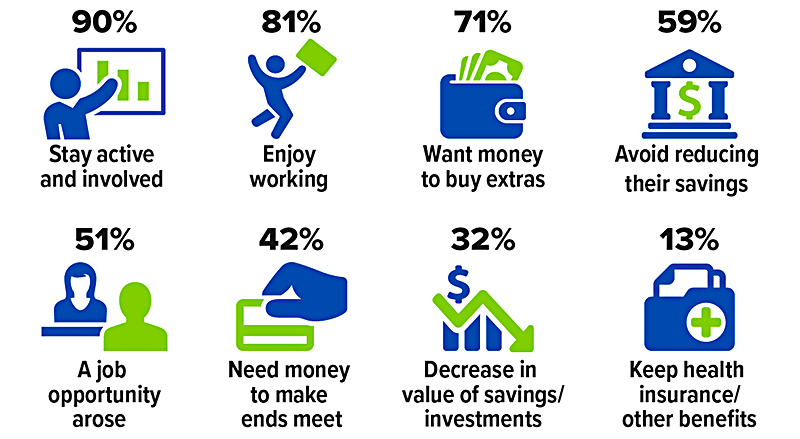
More than seven out of 10 current workers in a recent survey said they expect a paycheck to play a role in their income strategy beyond traditional retirement age. In fact, 33% expect to retire at age 70 or older, or not at all.1

If you expect to continue working during your 60s, 70s, or beyond, consider the advantages and disadvantages carefully. Although working can enhance your retirement years in many ways, you may also face unexpected consequences, particularly when it comes to Social Security.

Advantages

There are many reasons why you may want to work during retirement. First and perhaps most obvious, a job offers a predictable source of income that can help pay for basic necessities, such as food, housing, and utilities.

Working may also allow you to continue saving on a tax-deferred basis through a work-based retirement savings plan or IRA. Traditional retirement accounts generally require you to take minimum distributions (RMDs) after you reach age 73 or 75, depending on your year of birth; however, if you continue working past RMD age, you can typically delay RMDs from a current employer’s plan until after you retire, as long as you don’t own more than 5% of the company. (Roth IRAs and, beginning in 2024, work-based Roth accounts do not impose RMDs during the account owner’s lifetime.)

Moreover, employment can benefit your overall well-being through social engagement with colleagues, intellectual stimulation, and, if you’re employed in a field that requires exertion and movement, mobility and fitness.

Working may also provide access to valuable health insurance coverage, which can supplement Medicare after the age of 65. Keep in mind that balancing work-sponsored health insurance and Medicare can be complicated, so be sure to seek guidance from a qualified professional.

A paycheck might also allow you to delay receiving Social Security benefits up to age 70. This will not only increase your monthly benefit amount beyond what you’d receive at early or full retirement age, it will add years of earnings to your Social Security record, which could further enhance your future payments.

If one of your financial goals is to leave a legacy, working longer can help you continue to build your net worth and preserve assets for future generations and causes.

Why Retirees Work

Source: Employee Benefit Research Institute, 2023 (multiple responses allowed)

Disadvantages

There are some possible drawbacks to working during retirement, especially regarding Social Security. For instance, if you earn a paycheck and receive Social Security retirement benefits before reaching your full retirement age (66–67, depending on your year of birth), part of your Social Security benefit will be withheld if you earn more than the annual Social Security earnings limit. However, the reduction is not permanent; in fact, you’ll likely receive a higher monthly benefit later. That’s because the Social Security Administration recalculates your benefit when you reach full retirement age and omits the months in which your benefit was reduced.

After reaching full retirement age, your paycheck will no longer affect your benefit amount. But if your combined income (as defined by Social Security) exceeds certain limits, it could result in federal taxation of up to 85% of your Social Security benefits.

Perhaps the biggest disadvantage to working during retirement is … working during retirement. In other words, you’re not completely free to do whatever you want, whenever you want, which is often what people most look forward to at this stage of life.

Finally, a word of caution: Despite your best planning and efforts, you may find that you’re unable to work even if you want to. Consider that nearly half of today’s retirees left the workforce earlier than planned, with two-thirds saying they did so because of a health problem or other hardship (35%) or changes at their company (31%).2

For these reasons, it may be best to focus on accumulating assets as you plan for retirement, viewing work as a possible option rather than a viable source of income.

1–2) Employee Benefit Research Institute, 2023

This content has been reviewed by FINRA.

What Is The Average Retirement Savings By Age?

One of the most common questions when people hear I am a financial planner is some version of “Do you think I am on track for retirement?” The reality is most people could be saving more, but keep reading as we share the average retirement savings by age. Hopefully, this will give you a sense that you are on track or need to ramp up your savings for retirement.

Big Cheers if you are on track for retirement. Now you can pay to go see the Taylor Swif eras tour.Getty Images

What Is The Average Retirement Savings By Age?

If you are trying to see if you are on track for a secure retirement, you may wonder how much others your age have socked away. While I would love everyone to (eventually) become a 401(k) millionaire , many people need to save more and invest wisely enough to reach this big financial milestone.

Here are some numbers from Fidelity Investments showing the average 401(k) balance by age range.

  • Age 20-29 Average 401(k) Balance $12,800
  • Age 30-39 Average 401(k) Balance $43,100
  • Age 40-49 Average 401(k) Balance $100,300
  • Age 50-59 Average 401(k) Balance $175,400

I will point out that these are just averages. Even if your 401(k) balance is above these numbers, if your income is also above average, you may still be behind when it comes to reaching financial freedom and a secure retirement.

What Is The Median Retirement Savings By Age?

High and low savers can heavily skew average retirement savings. Some higher-income folks or super savers are likely bringing up the averages. On the flip side, quite a few people probably have an old 401(k) with just a few dollars in it, dragging down the averages. The median is the balance at which half of people have more and half have less saved in a 401(k).

  • Age 20-29 Median 401(k) Balance $4,600
  • Age 30-39 Median 401(k) Balance $16,200
  • Age 40-49 Median 401(k) Balance $32,100
  • Age 50-59 Median 401(k) Balance $53,400

As a retirement planner, it is scary to see how much lower the median 401(k) balance is than the average 401(k) balance.

What Is The Recommended Retirement Savings By Age?

The recommended retirement savings will depend on three main factors: your age, when you want to retire, and your income. Other things to consider are how much you will receive from Social Security, how much you will need/want to spend in retirement, as well as other sources of income.

Keep reading as we share some target retirement savings recommendations by age.

What Is The Average Retirement Savings For Married Couples By Age?

Married couples have some advantages and disadvantages when it comes to retirement planning. On the plus side, many expenses are similar, whether living alone or with a spouse. On the other hand, the odds are much higher that at least one-half of a couple will need long-term care.

All the same, the rules of thumb below can be used for singles or couples. However, if one spouse doesn’t work, these could underestimate the ideal amounts of retirement savings by age for married couples.

How Much Should I Have For Retirement By 30?

How much you should have saved for retirement by age 30 is related to how much you earn. You should strive to have at least one year of salary saved for retirement by the time you reach age 30. The median salary for people aged 25 to 34 is around $55,000. Ideally, you would be at least at this number, especially if your income is higher.

How Much Should I Have For Retirement By 40?

Four times your annual salary is the target for people who reach the ripe old age of 40. For example, if you earn $100,000, you should have at least $400,000 in your retirement account by age 40. If you are behind, now is the time to supercharge your 401(k) contributions.

How Much Should I Have For Retirement By 50?

If you are pushing 50, you should have around 7 times your salary in retirement accounts. From the average and median retirement account numbers listed above, quite a few people need to catch up when it comes to hitting this retirement account target. Age 50 seems to be when many people get serious about making work an option.

There is some good news for those 50 and older who need to supercharge their retirement savings : 401(k) contribution limits increase at age 50. For 2023, you can contribute an extra $7,500 via a catch-up contribution to your 401(k). This contribution amount is on top of the $22,500 regular 401(k) contribution limit. This total jumps to $73,500 for some self-employed business owners.

How Much Should I Have For Retirement By 60?

To stay on pace for your dream retirement or maintain your standard of living as you age, you should have at least 11 times your salary by age 60. More if you want to retire earlier than age 67.

The numbers above are just retirement-planning benchmarks. How much you need to retire will depend on your lifestyle and debt levels (if any). If you have paid off your mortgage and/or have a large pension, you will need to generate less income from your other retirement accounts to get by. On the other hand, if you love getting a new car every two years and are renting your apartment, none of those expenses are likely to drop much once you leave the workforce. They will likely continue to rise over time. That means you will need more money to maintain your standard of living in retirement.

The important thing is to get started if for no other reason than to lower your tax bill by opening a retirement account. Be sure to get every penny of your employer’s matching contribution . This is like free money from your boss. Becoming a 401(k) Millionaire is actually easier than it sounds.

By David Rae, Contributor

© 2024 Forbes Media LLC. All Rights Reserved

This Forbes article was legally licensed through AdvisorStream.

Why Women And Their Partners Should Plan For Her Second Retirement

A couple typically plans for their retirement. What is frequently overlooked is the reality that, on average, women live longer than men. Few retirement plans prepare surviving women for what is effectively her second retirement – a later life stage with new complexities, different needs, and costs just when financial resources and personal resilience may be sharply declining.


Couples must plan for a retirement and a half, one shared retirement, and then a plan for her living solo in a second retirement./Getty Images

According to the Centers for Disease Control, forecasted life expectancy at birth for women in 2019 was 81.4 years compared to men who can look forward to 76.3 years. However, by age 65, women are likely to live nearly another 21 years compared to men who squeeze in a little more than an additional 18 years. Those averages assume that the woman and her mate are the same age. According to Pew Research, women are typically 2-plus years younger than their spouses, thus adding a few more years. The takeaway? Women — and their partners — should plan on a retirement and a half, that is their retirement together, plus a near decade of her living without a spouse.

Essie, a 77-year old widow in Baltimore, lost her husband of five plus decades a few years ago. She laments that, “It’s just different now. We, (she quickly corrects herself) I did not plan on living without him and living alone.” She goes on, “I feel like it’s a whole other life I never imagined.”

Essie, and many women like her, are faced with what might be best characterized as a second retirement . The life after work they planned and saved for as a couple is the retirement many women may have dreamed of, but the life stage that follows is an unanticipated retirement that begins when their loved one passes.

A woman’s second retirement is likely to begin when she is at a much older age – past the years of checking off travel bucket lists, dreams of endless leisure, and other activities featured on today’s brochure images of retirement living. Financial resources are likely to be greatly reduced. Connections with friends and community may have decreased. She may now be managing multiple health conditions. Many of the home tasks that were once shared, e.g., food shopping, cooking, and cleaning, are now the job of one person. Despite the likelihood of these confounding complexities, few couples actively plan for her second retirement.

A recent TIAA study assessed financial and longevity literacy and found that while women may be lagging men in financial literacy, they have a greater understanding for how long they might live. The study found that when men and women were asked about how long they might expect to live, women came out ahead. According to Surya Kolluri, Head of the TIAA Institute ,

“…it has been long reported that financial literacy among women tends to lag that of men; when we reframed the question, we found in a flip of the script, women are more likely to demonstrate strong longevity literacy. 43% of women correctly answered the longevity literacy question, compared to 32% of men. A possible explanation of the difference could be that women have traditionally been more influential in healthcare decisions in the household, including those related to the care of older family members, which helps their longevity literacy.”

Knowing you might live longer is not the same as preparing to live longer. Moreover, the TIAA study shows that well over half of women, and two-thirds of men, were unaware of the longevity realities of women living longer.

Couples must plan for two retirements. It is the second retirement that most women will face alone and is likely to be the most costly and complicated. Costs include expenses accumulated from months or even years of caregiving, rising healthcare demands in advanced age, as well as supportive services that may be needed over time.

Complications arise when what was once a lifetime of teamwork, or at least a modest sharing of household tasks to meet everyday needs, suddenly becomes a job for one. Even if there are ample financial resources available, identifying the range of possible services that will be needed, along with who might be the trusted organizations or people to provide everything from routine household tasks to home care, becomes an entirely different set of retirement challenges.

Couples must look past the vision of one shared retirement and plan for her second and solo retirement. This requires candid conversations between couples, their adult children, and focused discussions prompted by financial professionals to plan for her financial security, access to trusted home services and care that she may need in her later years.

By Joseph Coughlin, Senior Contributor

© 2024 Forbes Media LLC. All Rights Reserved

This Forbes article was legally licensed through AdvisorStream.

Don’t Overlook This Key Factor When Considering Retirement Relocation

(Getty)

A long-neglected factor to consider when choosing a residence is becoming more and more important to those who relocate in retirement. Because many people don’t consider the factor, it’s causing a lot of financial pain.

The overlooked factor is homeowner’s insurance, something that most people take for granted when buying a home.

The problem is so acute that legislatures in Florida and California took actions in recent years to try to ensure affordable homeowner’s policies are available.

Yet, the problem continues to worsen.

Recently, major insurance companies have announced they would not write new policies in key states.

The insurers are concerned about higher claims from floods, storms, wildfires and more. Increased costs of repairing and rebuilding homes also weigh on insurers.

In addition, regulators are limiting the premium increases insurers can charge. Payouts on homeowners’ insurance claims more than doubled from 2019 to 2022 but premiums increased by only a third, according to an insurer’s group quoted in The Wall Street Journal .

Most recently, American International Group, also known as AIG, said it plans to reduce sales in affluent ZIP codes in New York, Delaware, Florida, Colorado, Montana, Idaho, and Wyoming. The company already restricted its California business.

At about the same time, Farmers Group announced it would not sell new policies in Florida.

State Farm and Allstate already pulled back from new California sales.

Florida’s been a tough market for homeowner’s insurance for years. Many insurers left the market, premiums soared, and the state created its own insurance program.

I’ve long cautioned that many people don’t consider enough factors when deciding whether and where to relocate in retirement.

The move often is more expensive than expected because of the lack of attention to details that seemed insignificant before the move but become important afterwards.

Homeowner’s insurance is such a factor. In many areas that have been attractive to retirees there now are fewer insurers offering new policies and the available insurance is expensive.

Be sure to investigate the homeowner’s insurance market before settling on where to move in retirement.

By Bob Carlson, Senior Contributor

© 2024 Forbes Media LLC. All Rights Reserved

This Forbes article was legally licensed through AdvisorStream.

How Will Healthcare Expenses Ruin Your Fabulous Retirement?

There is a persistent myth that healthcare is magically free after you’ve retired, partly thanks to Medicare. Ask any retiree with a health condition, and I assure you they will tell you medical care is not free. The estimated healthcare expenses in retirement may cause you to worry about running out of money. Hopefully, those high costs will encourage you to make healthier choices now.

The higher your income, the higher your premiums will be for Medicare. How much your household spends on medical expenses will ultimately depend on your health.


Sadly you don’t need to have a major illness or injury to face bankruptcy from medical expenses in the USA.AFP via Getty Images

A new study from Fidelity revealed the average 65-year-old couple retiring this year will need about $315,000 to cover healthcare costs. According to the report, “The estimate assumes retirees are enrolled in traditional Medicare, which between Medicare Part A and Part B covers expenses such as hospital stays, doctor visits and services, physical therapy, lab tests and more, and in Medicare Part D, which covers prescription drugs.”

I must point out that $315,000 is more than many households have saved for retirement. For singles, the retirement healthcare expenses are half that figure at $157,500. Remember, long-term care expenses are not included in that total. Ouch!

You may be saying, “I’m healthy. There is no way I will rack up those kinds of medical expenses!” Others may think, “I’ll be covered by Medicare at 65.” While I hope we all live to age 100+ and die peacefully in our sleep without any ailments or diseases, that will not be the reality for most.

Even the healthiest retirees must pay monthly premiums for Medicare Part B (which covers doctor visits and surgeries). Medicare premiums will also be incurred for medication with Part D. These two things alone make up about 35% of the estimated costs in retirement. At the same time, the remainder is the cost-sharing in and out of Medicare that you will have for co-payments and meeting Medicare deductibles.

Nursing home or long-term care costs, as well as dental-care expenses, will be extra. As you can see, things add up quickly. To put this in perspective, someone turning 65 today has around a 70% chance of needing long-term care at some point during retirement.

Wait. It Gets Worse.

These cost estimates from Fidelity Investments continue to go up year after year. If you plan to retire several years later, your expected costs will likely be much more than the current $315,000 estimate.

Digging back to 2002 (the first year Fidelity did its estimate), expected healthcare costs in retirement are up a whopping 70%. The cost increases are compounding well beyond inflation, which can devastat e those on a fixed income. Healthcare expenses you may barely be able to afford at 65 will likely be impossible at 85.

An HSA can allow for tax-free accumulation and withdrawals.getty

Will Health Savings Accounts Save The Day?

The Health Savings Account (HSA) is a tax-favored account for health care expenses. You get a contribution deduction, invested money can grow, and you can make withdrawals tax-free if used for qualified medical expenses. HSAs accompany high-deductible health insurance plans. Some people use them now (while working) like an additional retirement account by letting the account grow until much later in life. These individuals want to maximize the benefits of the account’s tax-free growth, like a Rich Person Healthcare Roth IRA.

Take Steps Now to Improve Your Health.

Sadly, even the healthiest lifestyle won’t wholly eliminate medical expenses, but it doesn’t hurt. I would prefer spending money on a gym membership, healthy food, and an annual physical versus a knee replacement or dialysis. Your healthier lifestyle choices should allow you to feel better and enjoy your life more.

Pay attention to your health and develop or maintain healthy habits. Healthcare, travel, and retirement will be much less expensive and more enjoyable if you are healthy and happy.

What Is Retirement Resilience—And How Can You Build It

Most people (69% of men; 81% of women) experience some sort of unexpected event after they retire, according to a recent survey conducted by Age Wave and Edward Jones. As a result, a very high percentage of retirees (93%) agree that preparation, flexibility, and willingness to adapt are keys to thriving in a potentially long retirement. That’s a good definition of retirement resilience.


Living a long time in retirement is like running a hurdle race./Steve Vernon

The report notes that the most common types of serious challenges experienced are having a family member or close friend pass away, health issues for yourself or your spouse/partner, and significant financial setbacks. It also reveals that the most disruptive challenges for most people are divorce and widowhood, both of which can cause significant financial setbacks.

If you’re married or have a committed partner, it’s sobering to realize that at some time in the future, one of you will pass away and the other one will be a survivor. As a result, it makes a lot of sense to plan for the inevitable.

Another sobering result from the survey is that less than one-third of respondents (30%) said they could afford a comfortable and secure retirement that lasts more than 20 years; that percentage drops to about one in seven (15%) when asked if they could afford a 30-year retirement. Yet a 20- to 30-year retirement is entirely possible for retirees currently in their early to mid 60s.

Let’s look at financial and lifestyle action steps to help you build retirement resilience.

Enhancing your financial resilience for a long retirement

What can you do to prepare and plan for life’s inevitable financial setbacks? Here’s a list of possible action steps you can take:

  • Make sure you have reliable sources of protected and variable retirement income that will last the rest of your life (and that of your spouse or partner), no matter how long you live.
  • Determine if you or your spouse will be financially OK after one of you passes away. Estimate the retirement income the surviving spouse would receive as well as their living expenses. All too often, the retirement income for the survivor drops by a larger amount than their living expenses do.
  • Estimate how much your variable retirement income could decrease during a market downturn. That might help you determine how much you might need to reduce your living expenses should that happen. Keep in mind that you’ll most likely experience a handful of stock market crashes, recessions, and downturns during your retirement.
  • Many retirees will also experience some form of cognitive decline in their later years. Develop a plan now for protecting your finances , well before the time you might need such a plan.
  • Determine whether your current home and community will be supportive when you or your spouse becomes frail in your later years. If it won’t be, you’ll want to find a home and community that can support you in your frail years, while you still have the vitality to make such a move.
  • Establish a plan to pay for personal care if and when you or your spouse become frail. Such a plan could include savings set aside for that exact purpose, home equity that’s held in reserve for such a need, the potential of taking out a reverse mortgage, or purchasing a long-term care insurance policy.

Building life resilience in retirement

While the above steps are important financial strategies, here are three lifestyle steps that are equally—if not more—important:

  • Maintain and improve your health by keeping a healthy weight, exercising regularly, eating nutritious food, and getting sufficient sleep.
  • Nurture a supportive network of family and close friends who can provide a convoy of support when you experience any of life’s inevitable challenges. And before that time, they’ll enrich your life as you enjoy their companionship.
  • Develop compelling reasons for getting up each morning and getting involved with other people. Reasons can include pursuing interests, volunteering, working part time, and activities with family and friends—it’s highly personal for you.

It might seem like a lot of work to prepare for a long retirement, but it’s well worth the effort. Nobody promised that it would be easy to live for 20 to 30 years in retirement.

This post just scratches the surface of exploring retirement resilience. The entire Age Wave/Edward Jones survey report is very informative and a critical read for retirees who take seriously the challenge of surviving and thriving during a long retirement.

PS: My father is the hurdler winning the race in the photo that accompanies this post. This photo aptly symbolizes the challenges of living well throughout retirement—inevitably life will present hurdles that you must negotiate. Imagine a hurdler who says “I would have won the race if not for the hurdles in the way.” My father trained diligently for his races, and I encourage you to prepare and train for your “retirement race” so you can come out a winner, too.

Retirement Plans for Small Businesses

If you own a small business and you haven’t set up a retirement savings plan, what are you waiting for? A retirement plan can help you and your employees save on taxes while saving for the future.

Tax advantages

A retirement plan can have significant tax advantages:

  1. Employers with 100 or fewer employees are eligible for a tax credit of up to $5,000 per year for the first three years for establishing a new retirement plan and up to $1,000 per eligible employee for the first five years for making employer contributions on behalf of employees who earn no more than $100,000. In order to qualify, the employer must have 100 or fewer workers earning at least $5,000 in compensation, including at least one non-highly compensated employee, and must not have maintained another retirement plan for the same group of employees during the previous three years.
  2. Employers are eligible for a tax credit of $500 for adding an auto-enrollment feature to their plans.
  3. On an ongoing basis, a portion of the amount you contribute to employee accounts is generally tax deductible (you may not take both deductions and credits for contributions in the same tax year).
  4. Contributions and earnings in traditional accounts grow on a tax-deferred basis. In Roth accounts, only earnings grow on a tax-deferred basis, but qualified withdrawals are tax-free. 1

Types of plans

Retirement plans are typically IRA-based (SEP and SIMPLE IRAs) or qualified [profit-sharing plans, 401(k) plans, and defined benefit plans]. In general, qualified plans are typically more complicated and expensive to maintain because they must comply with specific IRS and Department of Labor laws and rules. Also, qualified plan assets must be held either in trust or by an insurance company. With IRA-based plans, your employees own (i.e., “vest” in) your contributions immediately. With qualified plans, you can generally require that your employees work a certain numbers of years before they vest.

Recent law changes have made it easier and less expensive for small businesses to offer some types of qualified plans.

Simplified Employee Pension (SEP)

A SEP allows you to set up an IRA for yourself and each of your eligible employees. You contribute a uniform percentage of pay for each employee, although you don’t have to make contributions every year, offering you some flexibility when business conditions vary. For 2024, your contributions for each employee are limited to the lesser of 25% of pay or $69,000 (up from $66,000 in 2023). Most employers, including those who are self-employed, can establish a SEP. You may permit your employees to designate contributions as Roth contributions.

The plan must cover any employee aged 21 or older who has worked for you for three of the last five years and who earns at least $750.

SIMPLE IRAs

The SIMPLE IRA plan is available if you have 100 or fewer employees. Employees can elect to make pre-tax and/or Roth contributions in 2024 of up to $16,000 ($19,500 if age 50 or older; up from $15,500 and $19,000, respectively, in 2023). You must either match your employees’ contributions dollar for dollar — up to 3% of each employee’s compensation — or make a fixed contribution of 2% for each eligible employee, regardless of whether they contribute. (The 3% match can be reduced to 1% in any two of five years.)

Beginning in 2024, employers may make additional non-elective contributions to all employees of up to 10% of compensation or $5,000, whichever is less. Moreover, employers with no more than 25 employees may allow their employees to contribute 10% more than the standard and age-50 limits. Employers with 26 to 100 employees may allow higher limits as long as they provide either a 4% match or a 3% nonelective contribution.

Each employee who earned $5,000 or more in any two prior years, and who is expected to earn at least $5,000 in the current year, must be allowed to participate in the plan.

Profit-sharing plan

Typically, only you, not your employees, contribute to a qualified profit-sharing plan. Your contributions are discretionary — there’s usually no required amount each year, and you have the flexibility to contribute nothing at all in a given year (although your contributions must be nondiscriminatory, and “substantial and recurring,” for your plan to remain qualified).

The plan must contain a formula for determining how your contributions are allocated among employees. A separate account is established for each participant. Generally, each employee with a year of service is eligible to participate (although you can require two years of service if your contributions are immediately vested). Contributions for any employee in 2024 can’t exceed the lesser of $69,000 (up from $66,000 in 2023) or 100% of the employee’s compensation.

401(k) plan

With a 401(k) plan (technically, a qualified profit-sharing plan with a cash or deferred feature), employees can make pre-tax and/or Roth contributions in 2024 of up to $23,000 of pay ($30,500 if age 50 or older; up from $22,500 and $30,000, respectively, in 2023). Generally, each employee with a year of service must be allowed to contribute to the plan.

You can also make employer matching and/or profit-sharing contributions. Combined, employer and employee contributions for any employee in 2024 can’t exceed the lesser of $69,000, up from $66,000 in 2023 (plus catch-up contributions of up to $7,500 if your employee is age 50 or older) or 100% of the employee’s compensation. In general, each employee with a year of service is eligible to receive employer contributions, but you can require two years of service if your contributions are immediately vested.

401(k) plans are required to perform somewhat complicated testing each year to make sure benefits aren’t disproportionately weighted toward higher-paid employees. However, you may avoid discrimination testing if you adopt a “safe harbor” 401(k) plan. With a safe harbor 401(k) plan, you’re generally required to either match your employees’ contributions (100% of employee deferrals up to 3% of compensation, and 50% of deferrals between 3% and 5% of compensation), or make a fixed contribution of 3% of compensation for all eligible employees, regardless of whether they contribute to the plan. Those contributions must be fully vested.

You may also avoid discrimination testing by adopting a SIMPLE 401(k) plan. SIMPLE 401(k) plans are similar to SIMPLE IRAs in terms of contribution limits and eligibility requirements, but may also allow loans and hardship withdrawals. Because they’re qualified plans, they’re a bit more complicated to administer than SIMPLE IRAs.

In addition, beginning in 2024, employers with no other retirement plan (with limited exceptions) can adopt what’s known as a starter 401(k) plan. Designed to be low cost and easy to administer, starter 401(k) plans allow only employee contributions. Employees must be auto-enrolled at a minimum contribution rate of 3% (not to exceed 15%) and may contribute up to $6,000 in 2024 ($7,000 for employees age 50 or older).

Defined benefit plan

A defined benefit plan guarantees your employees a specified level of benefits at retirement (for example, an annual benefit equal to 30% of final average pay). In 2024, a defined benefit plan can provide an annual benefit of up to $275,000 (or 100% of pay if less), up from $265,000 in 2023. An actuary is generally needed to determine the annual contributions you must make to fund the promised benefit. Contributions may vary each year based on the performance of plan investments and other factors.

In general, defined benefit plans are too costly and complex for most small businesses. However, because they can provide the largest benefit of any retirement plan, and therefore allow the largest deductible employer contribution, defined benefit plans can be attractive to businesses with a small group of highly compensated owners who are seeking to contribute as much money as possible on a tax-deferred basis.

In general, the amount of employee compensation that can be taken into account when determining employer and employee contributions is limited to $345,000 in 2024, up from $330,000 in 2023.

1 A Roth distribution is qualified if the account has been held for at least five years and the distribution is made after the employee reaches age 59½, dies, or becomes disabled. Distributions prior to age 59½ or otherwise nonqualified distributions from Roth accounts may be subject to income taxes and a potential 10% penalty, unless an exception applies.

The following questions may help you determine which type of plan to offer:

  • How much do you want to save for retirement?
  • Do you want to fund your plan through employer contributions? Employee contributions? Both?
  • Do you want your plan to allow employees to make pre-tax and/or Roth contributions?
  • How much flexibility do you want in terms of employer contributions?
  • Are you looking for a plan with the lowest cost and easiest administration?

This content has been reviewed by FINRA.